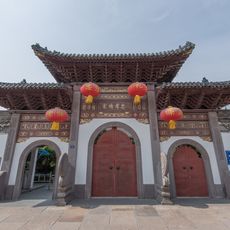
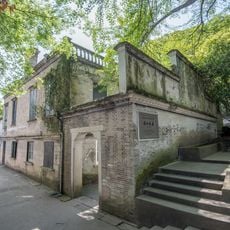
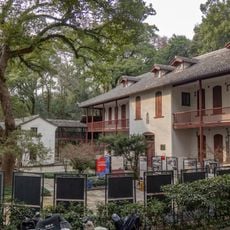
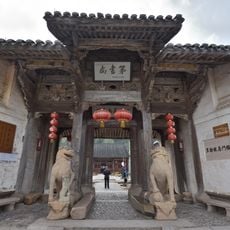
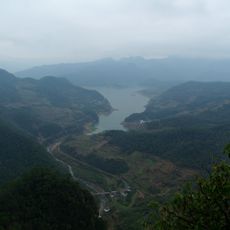
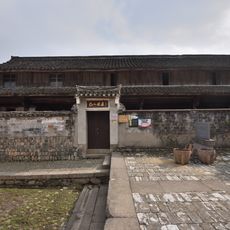
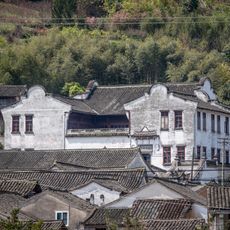
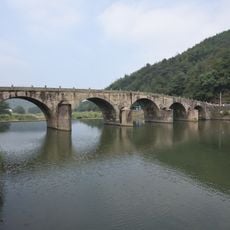
Gaoming Temple, Buddhist temple in Tiantai County, China.
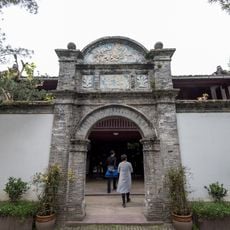
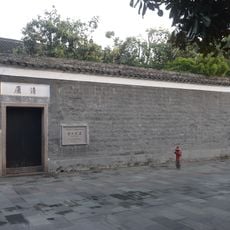
Gaoming Temple is a Buddhist sanctuary in Tiantai County arranged according to traditional Chinese building principles with multiple halls set along a central axis. The complex contains eight separate structures, including the Mahavira Hall, a Drum Tower, a Meditation Hall, and a library for Buddhist texts.
Zhiyi founded the temple in the 6th century as Youxi Daochang. It became Gaoming Temple in the Tianyou period (904–907) of the Tang, was renamed Zhizhe Youxi Tayuan in 936, and Jingming Temple in 1008. In 1606 abbot Youxi Chuandeng rebuilt the ruined complex with help from Feng Kaizhi and Zhao Hainan, adding 29 acres of land.
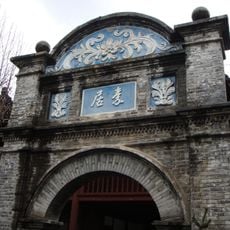
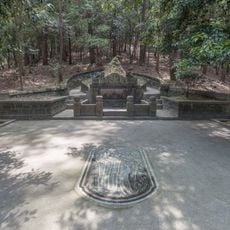
The temple's name comes from the Tang-dynasty Tianyou era (904–907), when the old Youxi Daochang became Gaoming Temple; in 1008 it was renamed Jingming Temple. Master Youxi Chuandeng, abbot from 1606, revived Tiantai Buddhism here and was honored as the "Rebirth of Zhiyi". The mountain gate and Mahavira Hall carry inscriptions by Kang Youwei, and beside the Qingliang Bridge southeast of the temple stands the brush tomb of Mingyu Chan master.
Visitors can walk through the eight halls, including the Guru Hall and Meditation Hall, to understand how a Buddhist temple is organized and used. It is helpful to move slowly through each area and respect the monks who may be engaged in daily practices.
The temple's name tablets at the Shanmen and Mahavira Hall were inscribed by Kang Youwei, the late-Qing reformer and calligrapher. Near the Qingliang Bridge southeast of the temple stands the brush stupa of Mingyu, a Chan master, and the two characters "Youxi" said to have been cut into the cliff by Zhiyi himself can still be seen.
The community of curious travelers
AroundUs brings together thousands of curated places, local tips, and hidden gems, enriched daily by 93,594 contributors worldwide.