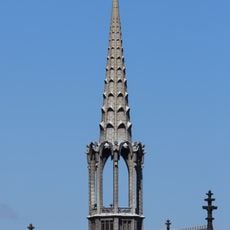
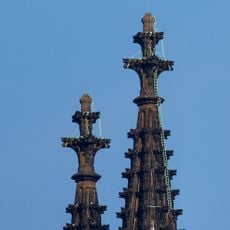
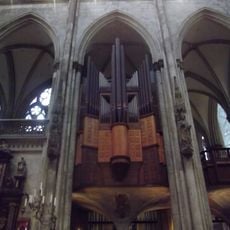
Petersglocke, Bell in Cologne Cathedral, Germany
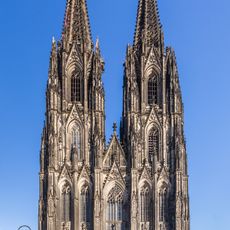
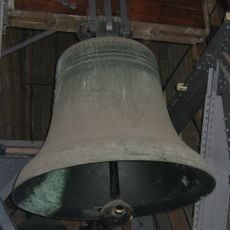
Petersglocke is a bell mounted in the south tower of Cologne Cathedral, cast in bronze and measuring 322 centimeters across. It hangs on a wooden frame and swings freely when rung, producing sound that carries across the entire city.
The Kaiserglocke of 1875, heavier at 27,180 kg, was melted down in 1918 for war metal. Heinrich Ulrich of Apolda cast its replacement on 5 May 1923, after other founders refused the risky commission. The bell was consecrated on 30 November 1924, and first rang out on Christmas Eve 1924, though a technical fault silenced it after three strokes until 28 October 1925.
Locals call it Decke Pitter, "Fat Peter" in the Kölsch dialect, while its official name honours Saint Peter. Its dedicatory inscription lists the German Reich, the Prussian State and Cologne citizens as donors, and a second inscription invokes Saint Gereon and Saint Ursula. It rang at midnight on 1 February 1926 to mark the end of the occupation of Cologne.
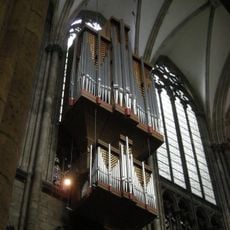
The bell hangs in the south tower belfry at a height of 53 metres and is not accessible to visitors; the tower climb does not reach it. Because the 3.22-metre bell could not pass the 1.84-metre main portal, the central pillar with the statue of Mary was removed to move it inside. Since 1984 light barriers switch off the drives at the maximum ringing angle.
Its deep C tone rings less frequently than the other tower bells, making each hearing a distinct experience. Only a handful of freely swinging bells worldwide exceed its size.
The community of curious travelers
AroundUs brings together thousands of curated places, local tips, and hidden gems, enriched daily by 92,840 contributors worldwide.