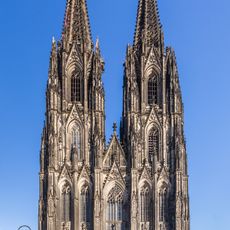
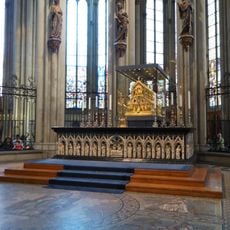
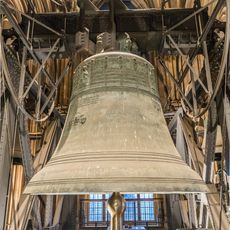
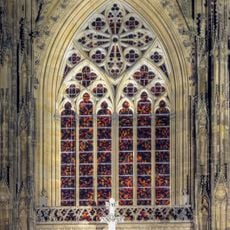
Crossing tower of Cologne Cathedral, Crossing tower in Altstadt-Nord, Cologne, Germany.
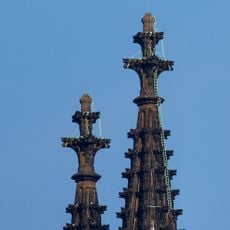
The crossing tower of Cologne Cathedral is a wrought-iron structure erected in 1860 above the crossing, immediately after the cathedral's roof truss was completed. It was designed by cathedral master builder Ernst Friedrich Zwirner with plans by his deputy Richard Voigtel. Since 1965–1973 it has been clad with Art Deco decorative elements, and eight angel figures of lead-covered larch wood, designed by Erlefried Hoppe, stand at the base of the spire.
The iron crossing tower was erected in 1860, directly after the cathedral's roof truss, to a design by cathedral master builder Ernst Friedrich Zwirner and plans by his deputy Richard Voigtel. A massive octagonal stone tower, as shown in Sulpiz Boisserée's 1821 ideal view, could not be built for structural reasons. The neo-Gothic decoration with gables, pinnacles and gargoyles was badly damaged in the Second World War, while the iron substructure stayed almost intact.
The tower's neo-Gothic decoration, with gables, pinnacles and gargoyles, was badly damaged in World War II while the iron frame survived almost intact. Between 1965 and 1973 it was re-clad in Art Deco forms, and eight lead-covered larch figures of angels by sculptor Erlefried Hoppe replaced the original gables at the base of the spire.
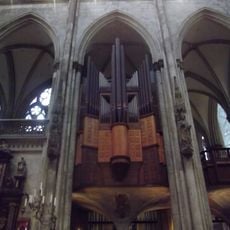
The tower can be seen from several spots within the cathedral, such as the main nave or the side aisles, offering different views of its structure. Visitors should move around to the various sections to fully appreciate how the iron frame works within the overall building.
Unlike other parts of the cathedral, this structure is made of iron, a material that did not exist for builders in medieval times. This technical solution enabled workers to finally complete the building's long construction story.
The community of curious travelers
AroundUs brings together thousands of curated places, local tips, and hidden gems, enriched daily by 92,711 contributors worldwide.