Kellerwald, Low mountain range in Hesse, Germany
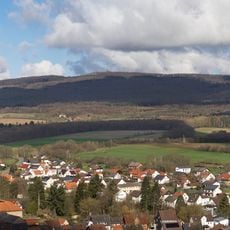
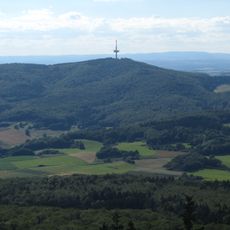
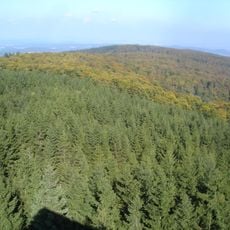
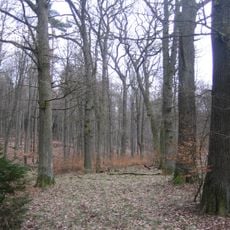
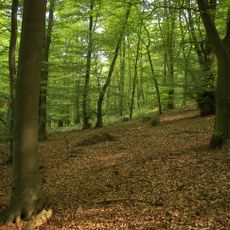
Kellerwald is a low mountain range of 514.5 km² in northern Hesse, reaching 675.3 m at the Wüstegarten, its highest summit. It is built mainly of Palaeozoic quartzite, shale, greywacke and diabase, and divided into the Hoher Kellerwald with Jeust and Keller in the south, the Mittelkellerwald, the Wildunger Bergland and the unpopulated Große Hardt in the north. Its beech woods form one of Germany's largest contiguous beech forest areas.
The name Kellerwald derives from the Keller ridge and is explained two ways: from about 1600 the woods were heavily used for charcoal to fuel ironworks and copperworks, giving Köhlerwald (charcoal makers' forest); alternatively from Kahler Wald (bare forest), after heavy clearing. Both could have produced today's name through sound shifts.
The name Kellerwald probably comes from Köhlerwald (charcoal-burner forest), as woodlands were heavily used for charcoal from about 1600 to fuel ironworks and copperworks; another reading is Kahler Wald (bare forest). Since the 19th century the northern woods, now the national park, were enclosed as hunting grounds of the Princes of Waldeck, so hunting rather than forestry shaped them.
The area is well organized with marked trails and information centers that help visitors navigate the terrain. The best time to visit is during summer and early autumn, when the paths are dry and easy to walk.
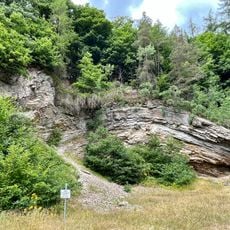
The Kellerwald agate, a dark red Eisenkiesel coloured by hematite inclusions, is a regional peculiarity found in these Palaeozoic rocks. The range's rocks also include Kellerwald quartzite, radiolarian rock, shale, greywacke and diabase.
The community of curious travelers
AroundUs brings together thousands of curated places, local tips, and hidden gems, enriched daily by 94,507 contributors worldwide.