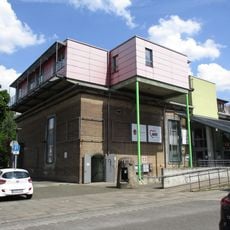
Bert-Brecht-Haus, Cultural education center in Oberhausen, Germany
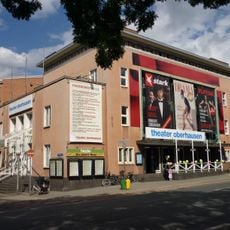
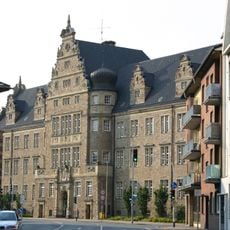
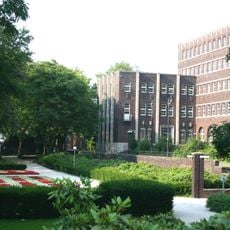
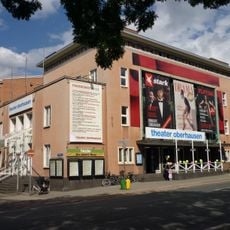
The Bert-Brecht-Haus is a seven-story brick building with expressionist features standing in downtown Oberhausen between Langemarkstraße and Paul-Reusch-Straße. It contains a library with thousands of books and media items plus spaces for educational programs and community events.
Built in 1928 to designs by Cologne architect Otto Scheib, the tapering brick building on a pointed plot was known as the Ruhrwachthaus, housing the Ruhrwacht newspaper's publishing house, editorial office and printing works, plus a Leonhard Tietz AG department store that passed to Kaufhof under the Nazis. After the store left in 1961 and the paper folded in 1967, the city bought it in 1978 for 1.4 million DM and reopened it in 1985 as the Bert-Brecht-Haus.
The building's name honours Bertolt Brecht, adopted when the former Ruhrwachthaus became a municipal centre in 1985. Since its reopening on 9 September 2011 it has served as a central meeting point in the city centre, drawing visitors to the Stadtbibliothek and listeners to the Volkshochschule. It has belonged to the Route der Industriekultur since 2011.
The Bert-Brecht-Haus stands between Langemarkstraße and Paul-Reusch-Straße in the city centre, a short walk from Oberhausen's main station. The building is a listed monument and has been on the Route der Industriekultur since 2011. Enter from the Langemarkstraße side; the Stadtbibliothek and Volkshochschule share the building, so signs point to each service separately.
The building's tapering shape comes from its wedge-shaped plot between Langemarkstraße and Paul-Reusch-Straße; it is often compared to Hamburg's Chilehaus. Since 2011 it has been a stop on the Route der Industriekultur, and the name honours Bertolt Brecht, though he had no personal link to Oberhausen.
The community of curious travelers
AroundUs brings together thousands of curated places, local tips, and hidden gems, enriched daily by 94,532 contributors worldwide.