Rhine Bridge, Steel truss railway bridge in Worms, Germany.
The Rhine Bridge at Worms is a two-track railway bridge crossing the Rhine at kilometre 445.45, about two kilometres north of the city. Its current steel structure, built in 1960, has three main spans of 104.4 m, 118.3 m and 104.4 m, with parallel trusses 9.0 m high and the tracks on the lower beam. The eastern flood bridge consists of 17 spans of 35.25 m.
The original bridge opened in 1900 using a construction method new to German railway engineering at the time. After destruction during World War II in 1945, the current structure was rebuilt in 1960 using modern engineering methods.
The bridge's axis shifted 26 metres upstream for the 1948 temporary crossing, forcing new piers in the river and curved approach ramps. Until the Nibelungen Bridge opened in 1953, the single track lay in the roadway, so a supervisor at Worms-Brücke halt alternated rail and road traffic, with trains limited to 30 km/h.
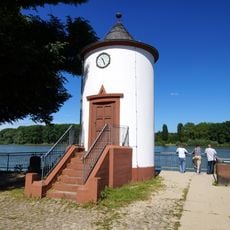
The bridge carries only railway traffic and cannot be walked across. The best close view is from the Worms bank near the former Worms Brücke halt, about two kilometres north of the Nibelungenbrücke road crossing. The eastern flood bridge rests on 17 piers at 35.25-metre intervals, and the track joint at the western end allows movements of up to 700 mm.
The 1900 bridge used tied-arch trusses over the Rhine, a type applied for the first time on a German railway bridge and later reused on the Cologne South Bridge. Its designer, Aachen professor Georg Frentzen, won the competition with the Duisburg firm Johann Caspar Harkort.
The community of curious travelers
AroundUs brings together thousands of curated places, local tips, and hidden gems, enriched daily by 92,697 contributors worldwide.