Bürgerpark, Public park in Braunschweig, Germany
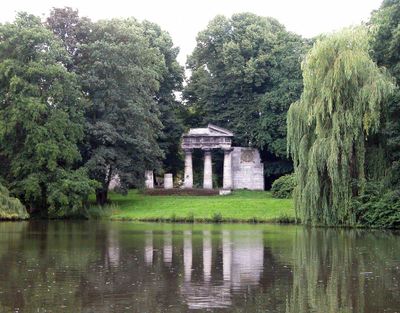
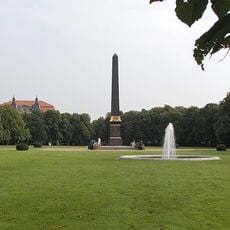
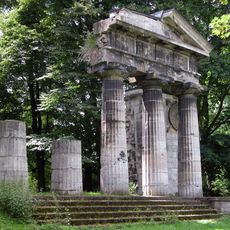
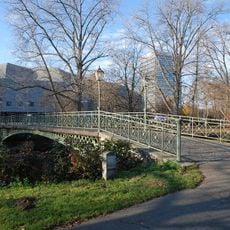
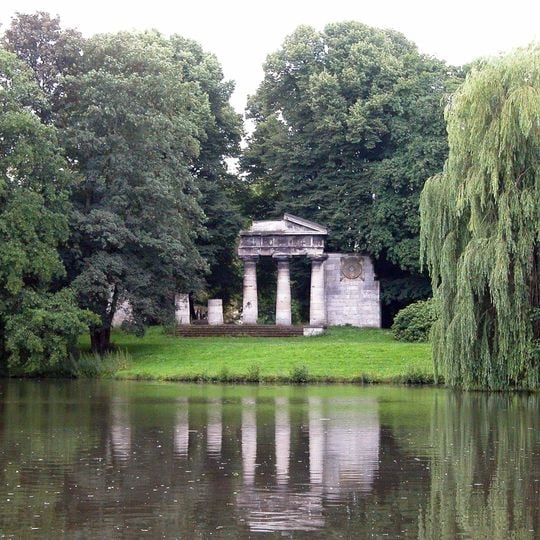
Bürgerpark is a 42-hectare landscape park in mixed style south of Braunschweig's old town, laid out from 1886 to 1925. It contains the one-hectare Portikusteich pond with weeping willows and a columned portico designed by Peter Joseph Krahe, moved here in 1896 from the former Augusttor gate and deliberately left as a ruin after World War II damage. The 4.5-hectare Südteich lies in the southern section.
The park was established starting in 1886 under garden architect Kreiss, who transformed swampy meadows and river loops of the Oker into a structured green space. This development shaped the city's landscape and created a new recreational area for residents.
The park's name recalls its civic funding: citizens bought the meadow south of the railway in 1891 so the former Eisenbahnpark could be extended as a public Bürgerpark. The Badetwete path still marks the route to a former river bathing station on the Oker, and the Kreißberg is popularly called Scherbelberg because it was heaped up from household rubbish and rubble.
The park lies south of the old town, bounded by Theodor-Heuss-Straße to the west and Wolfenbütteler Straße to the east, with a railway embankment to the south. Paths lead north into the Kiryat-Tivon-Park and south toward Richmondpark and the Südsee. The Kreißberg, an artificial hill about 16 metres above Eisenbütteler Straße, gives an overview of the grounds.
The 54-metre tower near the Oker is not a water tower but a chimney of the steam engine that drove the waterworks pumps, clad in Muschelkalk limestone so it would fit the old town skyline. The water main ran up inside it to keep pressure constant, and the plans call it a Druckthurm. It has leaned for decades and was stabilised in the 1990s for about 800,000 DM.
The community of curious travelers
AroundUs brings together thousands of curated places, local tips, and hidden gems, enriched daily by 94,644 contributors worldwide.