Luckhardt-Villa, Single-family detached home in Westend, Germany
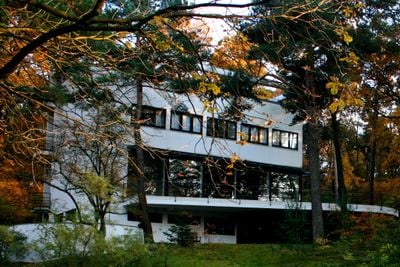
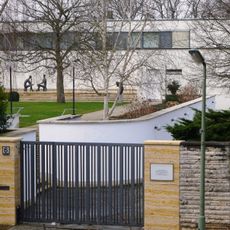
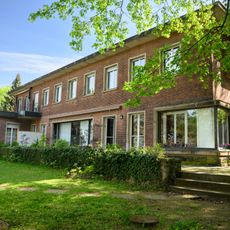
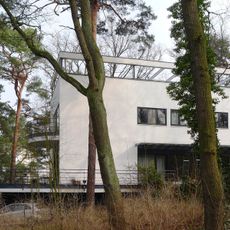
The Luckhardt-Villa is a three-storey, cubic steel-skeleton house built in 1929 by Hans and Wassili Luckhardt with Alfons Anker in the New Objectivity style. Philipp Holzmann AG filled the frame with pumice concrete and slabs, finished on both sides with white encaustic-treated render. Sliding horizontal window bands and a curved terrace with a short glass roof link the living hall to a garden by Berthold Körting; the roof terrace has a pergola and a floating cornice.
The house was built in 1929 by architects Hans and Wassili Luckhardt with Alfons Anker, embodying new housing ideals of the Weimar Republic. Though threatened during the Nazi era, it survived World War II and remains standing today.
The interior showcases furniture from the Bauhaus period that demonstrates how function and form work together in living spaces. The rooms reflect design principles that shaped how people thought about modern homes at that time.
The villa is a privately owned, restored single-family home and is not open to the public, so visits and guided tours are not possible. It stands at Am Rupenhorn 25 at the corner of Heerstraße in Westend; the white cubic volume, the curved terrace and the garden by Berthold Körting can be seen from the public street.
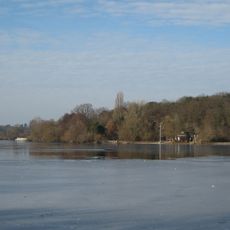
From the roof, one can see Teufelsberg hill, Stößensee lake, and Heerstraße street, while a pergola and floating cornice line define the rooftop design. These views and details show how the architects connected the house to its surroundings.
The community of curious travelers
AroundUs brings together thousands of curated places, local tips, and hidden gems, enriched daily by 94,255 contributors worldwide.