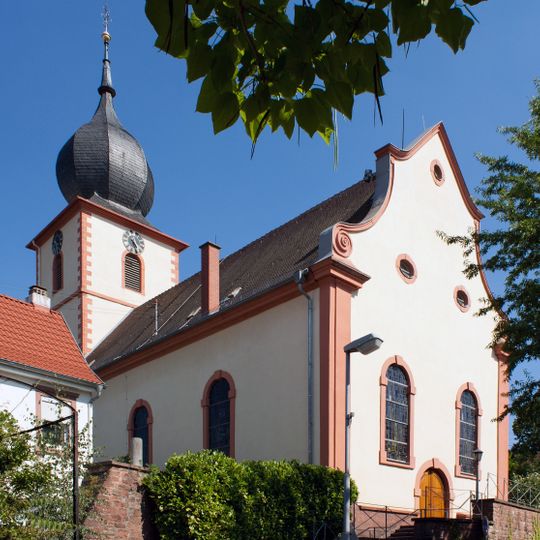
Evangelische Kirche Großsachsen, Protestant church in Hirschberg an der Bergstraße, Germany.
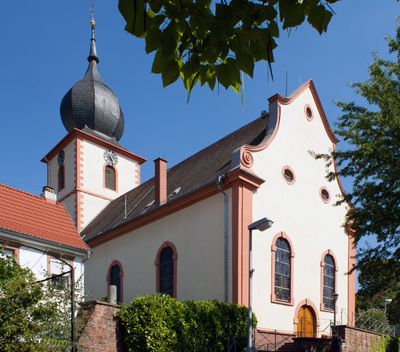
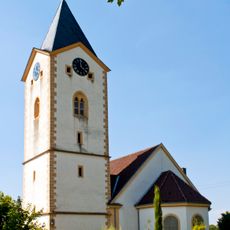
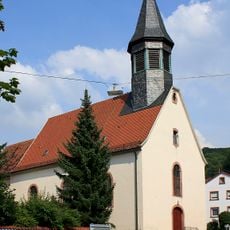
The Evangelische Kirche Großsachsen stands on elevated ground in the village centre. Its nave has three window axes and a saddle roof; pilasters at the corners carry a volute gable. The square tower, rebuilt 1760–1762 on old foundations, bears a clock and a dark grey onion dome that became the village landmark. The interior is laid out as a transverse church with galleries on three sides.
A chapel dedicated to Mary Magdalene is documented in the Wormser Synodale of 1494. French troops destroyed the church in 1674 during the Dutch War; it was rebuilt, then replaced in 1724 by a new nave by F. Born, retaining the tower and gateway. The tower collapsed after a storm in 1734, and the present tower was built on the old foundations between 1760 and 1762 to plans by J. G. Scherer.
The church's interior is laid out as a transverse church (Querhauskirche), a form typical of 18th-century Reformed congregations, with galleries on three sides. The pulpit dates from 1762. The three choir windows were designed in 1965 around the themes of creation, redemption and sanctification; altar, font, standing cross and ambo were shaped by Madeleine Dietz in 2006.
The church stands on elevated ground in the centre of Großsachsen, its tower's onion dome visible from the surrounding streets. The entrance is reached by steps at the front facade, so access is not step-free. Exterior renovations took place in 1972 and 1998, and the interior was rebuilt between 2005 and 2006.
The tower's onion dome, built 1760–1762 on the old foundations after the previous tower collapsed in a storm, became the emblem of the community. The three choir windows, designed in 1965, depict creation, redemption and sanctification. The 1991 Heintz organ reuses stops from its 1898 predecessor.
The community of curious travelers
AroundUs brings together thousands of curated places, local tips, and hidden gems, enriched daily by 93,669 contributors worldwide.