Cappenberg Castle, Medieval monastery and castle in Selm, Germany
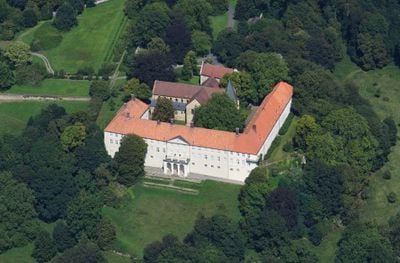
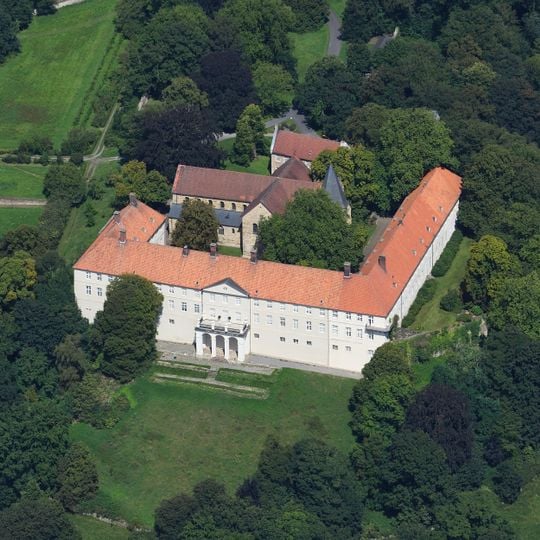
Cappenberg Castle is a former Premonstratensian abbey on the Cappenberg hill by Selm. Its three Baroque wings, built from 1708, enclose a courtyard and the Romanesque abbey church of St. Johannes Evangelist, which the buildings surround on three sides. The pale walls have rows of rectangular windows under steep red-tiled roofs; a projecting entrance bay carries a triangular pediment.
Founded in the 12th century by Count Gottfried, the monastery became an important Premonstratensian center in the region for centuries. The site suffered damage during the Thirty Years' War and later passed into Prussian hands in 1803.
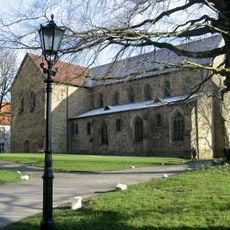
The name Cappenberg comes from the counts who held the hill; after 1122 it passed to the Premonstratensians, whose abbey church of St. Johannes Evangelist still serves the Catholic parish, as it has since 1832. In the west wing are kept the archives of Baron vom Stein, who lived here from 1824 until his death in 1831, and the former monastery's records. Concerts and art exhibitions are held in the buildings regularly.
The complex is reached from the north-west through an oak-lined avenue flanked by two stone lions on pedestals. The former abbey church of St. Johannes Evangelist, now the parish church, stands within the three Baroque wings. A water tower built in 1899, restored in 1992, stands on the castle grounds, next to a wildlife reserve and a bird of prey sanctuary.
A rare gilded bronze portrait of Emperor Frederick Barbarossa from the 12th century is housed in the abbey church, demonstrating the site's early importance. This sculpture remains one of few surviving imperial memorials from that era.
The community of curious travelers
AroundUs brings together thousands of curated places, local tips, and hidden gems, enriched daily by 92,856 contributors worldwide.