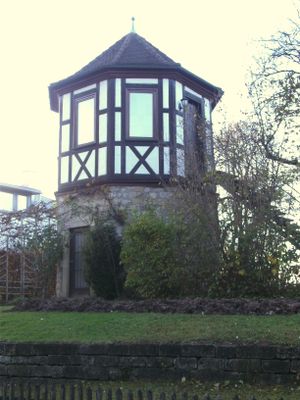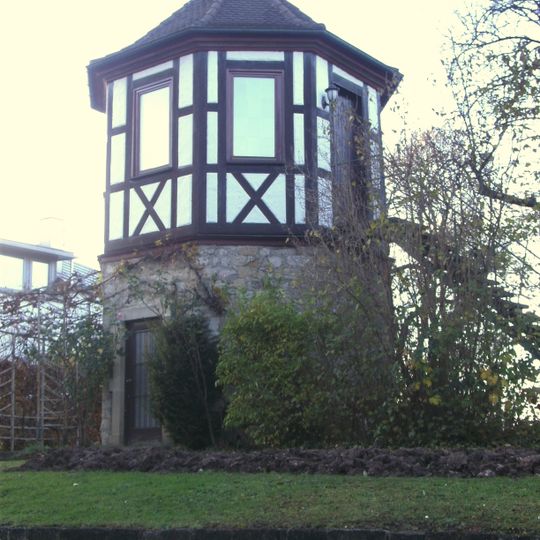
Goethehäuschen, Octagonal garden house on Schlossberg, Tübingen, Germany.
The Goethehäuschen is an octagonal garden house on the ridge of the Schlossberg, west of Tübingen's old town and Hohentübingen Castle. Its exposed half-timbered construction, uncovered during the 1961 renovation, contrasts with the documented earlier states of the building.
The house gained its name after Johann Wolfgang von Goethe visited the location during an evening walk with publisher Johann Cotta in September 1797. The structure underwent various modifications over time before being restored closer to its original form in the modern era.
The name Goethehäuschen recalls Goethe's visit to his publisher Johann Friedrich Cotta on 7 September 1797. At that time the octagonal garden house belonged to the pharmacy professor Christian Gottlieb Gmelin. A different Goethehäuschen stands on the Kickelhahn near Ilmenau.
The Goethehäuschen stands on the crest of the Schlossberg, reached on foot via paths climbing west from Tübingen's old town past Hohentübingen Castle. The ground is uneven and the slope steady, so sturdy shoes help. The city acquired the site in 1957 and renovated the building in 1961; a new cultural use is planned as of 2025, so access may change.
The city of Tübingen bought the plot in 1957 specifically to save it from planned new construction, then renovated the house in 1961. That renovation deliberately exposed the timber framing, departing from the documented earlier appearance. The building was later listed as a monument, and a new cultural use was being planned as of 2025.
The community of curious travelers
AroundUs brings together thousands of curated places, local tips, and hidden gems, enriched daily by 94,061 contributors worldwide.