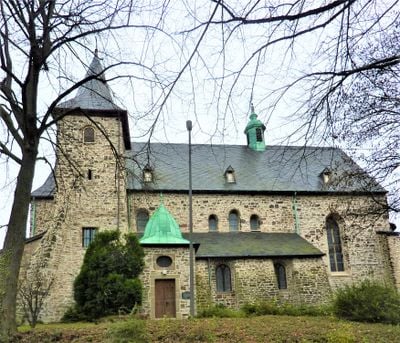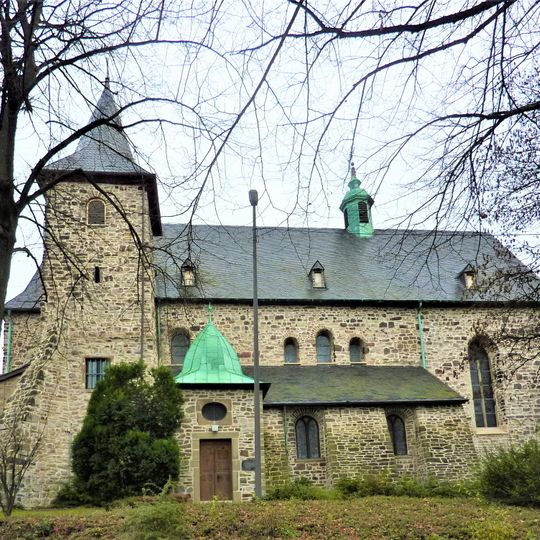
Stiftskirche Stoppenberg, Romanesque church in Stoppenberg district, Essen, Germany.
The Stiftskirche Stoppenberg is a three-aisled, two-bay pillared basilica of Ruhr sandstone, completed around the mid-12th century, with a square choir and semicircular apse. It is among the earliest vaulted basilicas in the Rhineland, though the vaults were not rebuilt after 1945 war damage. Of the western twin towers only the south tower survives at full height; the west gallery was extended when the convent grew.
Abbess Swanhild founded the church, and Archbishop Anno II consecrated it in 1074 as the Nikolauskapelle. It served a Premonstratensian double monastery in the 12th century; by the 13th century only the nuns remained, and in the 15th century it became a secular women's foundation limited to twenty canonesses. The foundation was dissolved in 1803, and the church remained the parish church until 1907. Since 1965 Discalced Carmelite nuns have lived beside it.
The name Stoppenberg traces back to a sanctuary dedicated to a saint that once occupied this hilltop. Today, Carmelite nuns use the building for their daily prayer community, shaping the spiritual life of this place.
The church grounds subsided about 12 meters (39 feet) between 1900 and 1985 due to mining activities in the surrounding industrial area. Visitors should be aware of this geological history when exploring the site and examining the foundations.
The church holds the grave of Franz Ferdinand Freiherr von der Wenge, a canon of Münster Cathedral who founded the St.-Antony-Hütte near Oberhausen-Osterfeld in 1758, the ironworks with which the Ruhr's iron and steel industry began. The tomb lies in the church itself, not in a crypt.
The community of curious travelers
AroundUs brings together thousands of curated places, local tips, and hidden gems, enriched daily by 92,769 contributors worldwide.