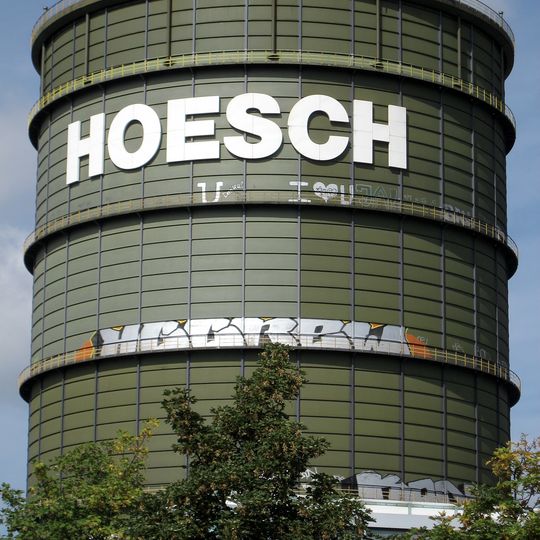
Gasometer Phoenix-West, Industrial heritage monument in Dortmund, Germany.
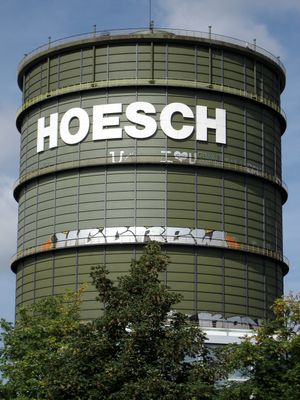
The Hoesch-Gasometer is a former low-pressure gas holder of the Hoesch AG in Dortmund-Hörde, a cylindrical steel structure 76.5 meters high with a diameter of 49 meters and a capacity of 120,000 cubic meters. Inside, a ceiling disc floats at varying heights depending on the amount of gas stored, as is usual for low-pressure gas holders. It stored blast furnace gas from the Phoenix-West furnaces and, until 1964, coking gas from the on-site coking plant.
Built as part of the Phoenix-West steelworks, the gas holder stored blast-furnace gas from the Phoenix-West furnaces and, until 1964, coking gas from the on-site coking plant. After that plant closed, pipes along the Emscher carried coking gas from the Hansa coking plant in Huckarde, which the holder also stored from 1966. The gasometer survived the demolition of the ironworks and has been a listed monument since March 2002.
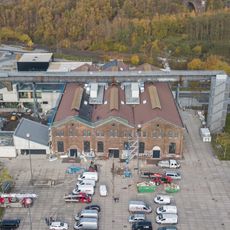
The gas holder is a station on the Route der Industriekultur, the Ruhr's route of industrial heritage sites. Its name recalls the Hoesch AG steel company, and it stands as a landmark of Hörde visible from afar. The surrounding Phoenix-West site was demolished, leaving the gas holder as one of the remaining structures.
The gas holder stands on the former Phoenix-West grounds in Hörde, southern Dortmund, and is listed as a monument since March 2002. It is a stop on the Route der Industriekultur, so it is best reached on foot or by bike along the Emscher. The steel shell is not open to the public; visitors view it from outside.
The gas holder's roof is a floating disc that rises and falls with the amount of gas stored inside, a feature typical of low-pressure holders. The site was demolished after the blast furnaces shut down, but the gas holder was kept and listed as a monument in March 2002.
The community of curious travelers
AroundUs brings together thousands of curated places, local tips, and hidden gems, enriched daily by 94,423 contributors worldwide.