Tritonbrunnen, Baroque fountain in the old town of Nuremberg, Germany
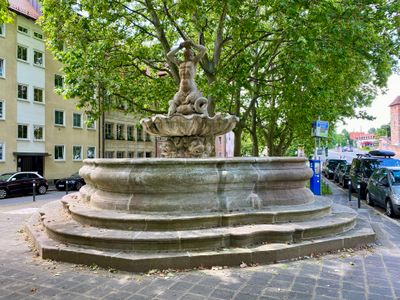
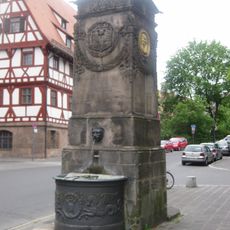
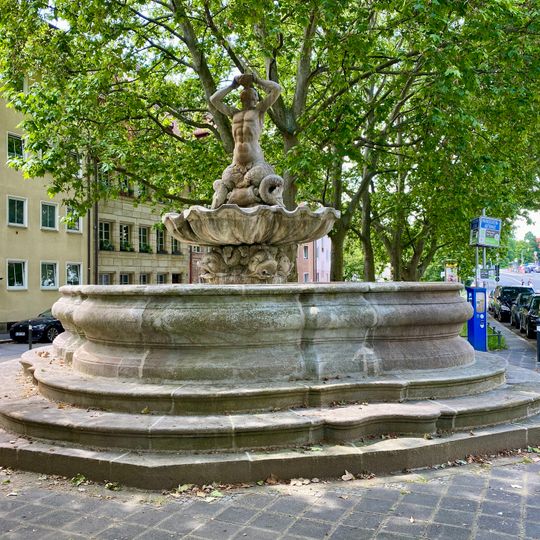
The Tritonbrunnen stands in the middle of Maxplatz: a three-stepped sandstone base carries a broad, four-lobed basin, from whose centre a pillar with four dolphin heads supports a shell-shaped bowl. Above it, a kneeling Triton holds a dish over his head, sending water down over his body into the bowl and basin.
The Tritonbrunnen was created in 1689 by Johann Leonhard Bromig II for the elongated Maxplatz, a Baroque square. A council record of 22 July 1684 already asked whether a public fountain should be built on the Neuenbaw. It was damaged in January 1945 and restored in 1953, with the shattered Triton figure reconstructed by sculptor Albert Feist.
The fountain is dedicated to Triton, son of Poseidon and Amphitrite; Greek myth and water allegories were a typical theme of the early secular Baroque. Its freedom from Christian symbolism reflects Nuremberg's humanist milieu, shaped by Philipp Melanchthon, 140 years after the Reformation. The Triton statue is accepted as Bromig's own work.
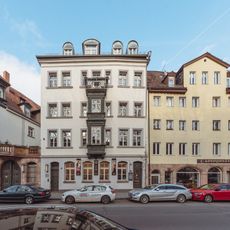
The fountain stands in the middle of the elongated Maxplatz, whose central green was partly cut back when the square was rebuilt for traffic in 1967; the basin is on a low stepped platform. The Dürer-Pirckheimer-Brunnen, added on the square in 1821, is a second reference point. The water runs only in the warmer months.
The fountain is a free adaptation of Bernini's Fontana del Tritone in Rome (1642–1643). A 1685 Nuremberg engraving collection, "Der Römischen Fontanen Wahre Abbildung" by Siegfried Froberg, reproduced the Roman fountain, though no stay in Rome by Bromig is documented. Unlike Bernini's open shell, the Nuremberg version has a solid pillar with four dolphin heads.
The community of curious travelers
AroundUs brings together thousands of curated places, local tips, and hidden gems, enriched daily by 94,044 contributors worldwide.