Jüdischer Friedhof, Jewish cemetery in Mainz, Germany.
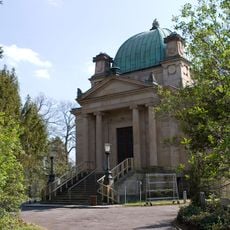
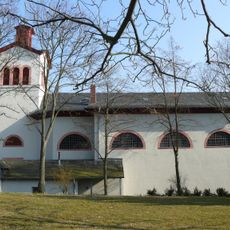
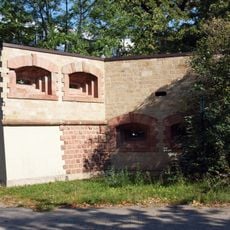
The Jüdischer Friedhof is a 20.7-hectare cemetery on Zahlbacher Straße/Xaveriusweg, bordering the main city cemetery to the north. Its brick mourning hall, built to plans by city architect Eduard Kreyßig, has a one-storey orientalising facade with onion-domed corner pillars, a crenellated arch canopy over the entrance and horseshoe arches inside. Graves are laid out in numbered fields, from simple inscribed stones to classicist monuments such as obelisks and aediculas.
The Israelitische Religionsgemeinde bought the site in 1878 after the older Judensand cemetery ran out of space, and burials have taken place here since 2 January 1881. On that day the cemetery was inaugurated and the mortuary hall with its tahara room, planned by city architect Eduard Kreyßig, was handed over to community head Moritz Oppenheim. A memorial plaque was added in 1948.
The gravestones carry Hebrew inscriptions and symbols that show how Jewish communities here honored their dead across many centuries. Walking through the rows, you can see how burial practices and memorial styles changed over time, reflecting the life of the community.
The cemetery lies on Zahlbacher Straße/Xaveriusweg, directly south of the Mainzer Hauptfriedhof. It is open April to September from 8 to 19, October to March from 8 to 17, but closed on Saturdays and Jewish holidays. On 1 November it joins the Tag des Friedhofs held at the neighbouring main cemetery.
The 1948 memorial plaque on the cemetery reads: "To our victims in remembrance, to the murderers in shame, to the living as a warning." The cemetery and its mourning hall are protected as a monument zone; the hall is among the most important of the seventeen surviving buildings of its kind in Rhineland-Palatinate.
The community of curious travelers
AroundUs brings together thousands of curated places, local tips, and hidden gems, enriched daily by 94,362 contributors worldwide.