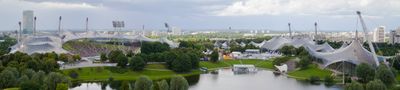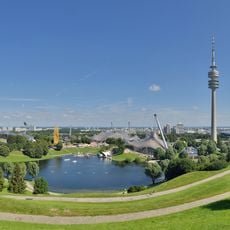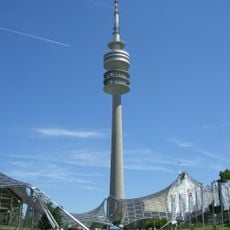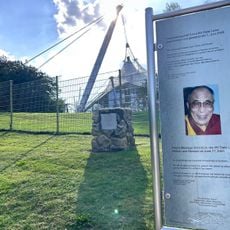
Olympic Roof Munich, Architectural heritage monument in Milbertshofen-Am Hart, Germany.
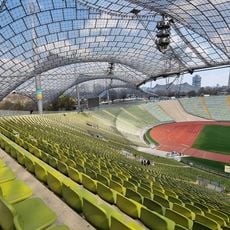
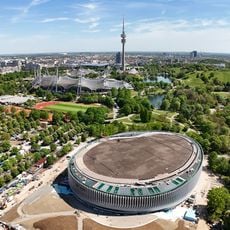
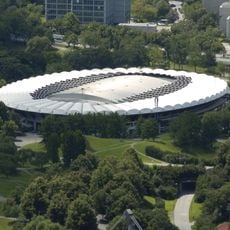
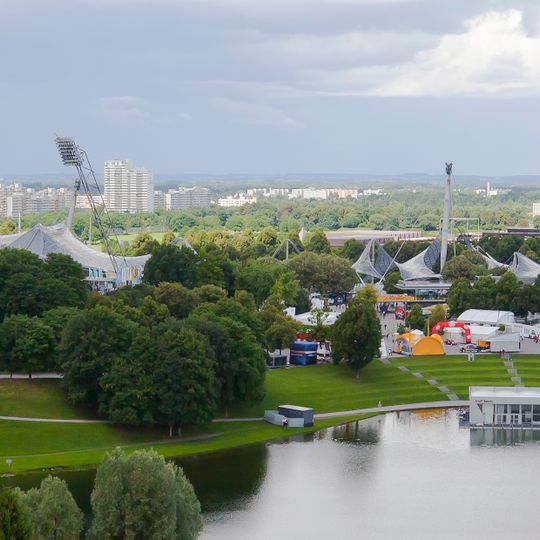
The Olympic Roof Munich is a vast acrylic glass covering held up by a system of steel cables stretched across the stadium grounds. The cable network forms saddle-shaped sections that work together to shed rain while allowing daylight to pass through and illuminate the spaces below.
Completed in 1972, this roof was designed through collaboration between architects and engineers who wanted to prove that large stadiums could be covered without looking heavy or closed. The project changed how people thought about building coverings for major sporting venues.
Locals call it the Olympia-Zeltdach, the Olympic tent roof. Its competition entry was improvised with wooden sticks and a piece of nylon stocking. The 1972 acrylic panels turned milky from iron oxidation added for fire protection and were replaced by 2002.
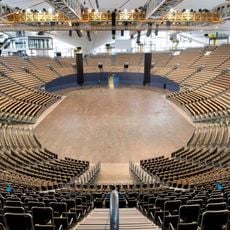
The roof is not climbed; visitors view it from the paths of the Olympiapark between the stadium, Olympiahalle and Olympia-Schwimmhalle. The south side meets Coubertinplatz and Hans-Jochen-Vogel-Platz, with the Olympiasee beyond. The 3 × 3 metre panels sit on a cable net whose nodes are 75 centimetres apart, so look up to read the grid.
The roof's cable net is made of nodes spaced exactly 75 centimetres apart, woven on the ground and then hoisted into place. A single 440-metre round cable runs from the stadium's north side over the main stand to the south side, anchored by concrete blocks weighing 4,000 tonnes, some sunk 30 metres deep.
The community of curious travelers
AroundUs brings together thousands of curated places, local tips, and hidden gems, enriched daily by 92,922 contributors worldwide.