Rote Burg, Historic townhouse in Aachen, North Rhine-Westphalia, Germany
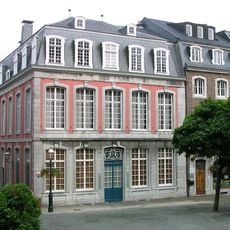
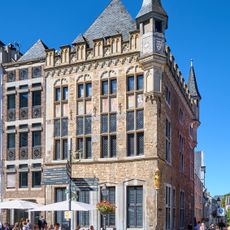
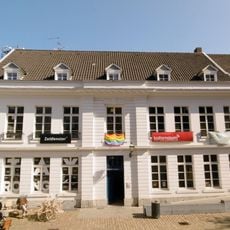
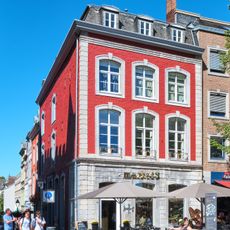
The Rote Burg at Büchel 14 in Aachen is a two-storey house with a steep gabled roof facing the street. Its five window axes sit close together, separated only by blue-stone frames, and the ground-floor windows reach the floor. The present facade goes back to the rebuilding of 1671/72; since 2018 the building has housed the Büchel-Museum.
The original building from the mid-15th century belonged to the Segraedt family, which supplied several mayors of the imperial city of Aachen. It was first called Rosenburg, and the name Rote Burg is documented from the 17th century. The town fire of 1656 destroyed the timber-framed house; only the vaulted stone cellar survived. In 1671/72 the copper master and councillor Folquin Fibus rebuilt it as a two-storey house with a low mezzanine, and this reconstruction essentially shaped today's facade.
The name Rosenburg, documented before the 17th-century shift to Rote Burg, recalls the Segraedt family of Aachen aldermen who owned the house and supplied several mayors of the imperial city. From the mid-1960s the ground floor held the student tavern "Alte Burschenherrlichkeit", whose menu illustrations drew on student fraternities, followed by Charly's Leierkasten. Since 2018 the building has housed the Büchel-Museum, opened with some 200 works by Emil Orlik.
The building is at Büchel 14, where the entrance door sits in the second axis from the right, reached by a single step, with a separate cellar entrance in the right-hand axis. Since 2018 the ground floor and cellar have housed the Büchel-Museum, opened with around 200 works by Emil Orlik; the former kitchen serves as an exhibition room. The five window axes stand close together, separated only by blue-stone frames.
Since 2018 the building has housed the Büchel-Museum, opened with an exhibition of about 200 works by the Bohemian painter and graphic artist Emil Orlik. The former kitchen was converted into an exhibition room; otherwise no structural changes were needed. The museum shows graphics and art from the 19th century to modernism.
The community of curious travelers
AroundUs brings together thousands of curated places, local tips, and hidden gems, enriched daily by 92,775 contributors worldwide.