Aachen Altstadt, Medieval district in Aachen, Germany.
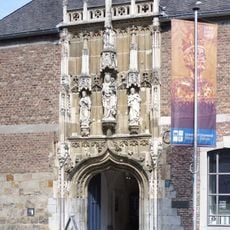
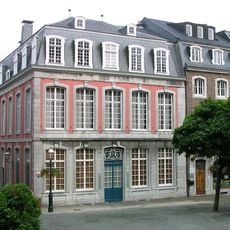
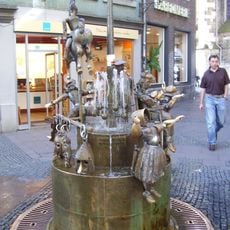
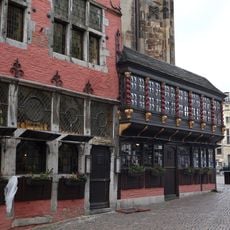
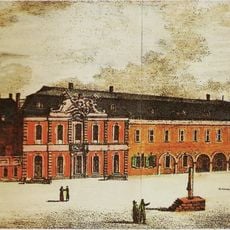
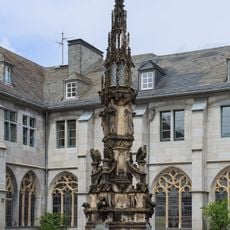
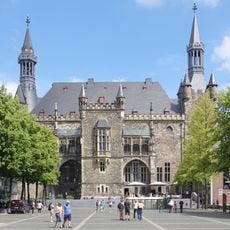
Aachen's old town is a district with narrow lanes, several fountains, and buildings from different periods arranged around a central market square. The architecture ranges from medieval structures to Renaissance and later additions.
The district received city rights from Emperor Frederick Barbarossa in 1165, becoming a free imperial city within the Holy Roman Empire. This grant marked the beginning of its development into an important urban center.
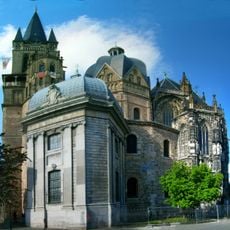
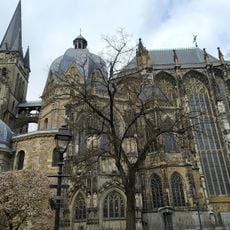
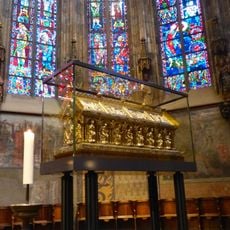
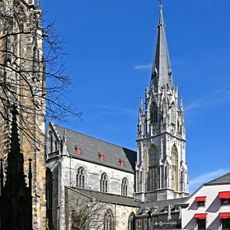
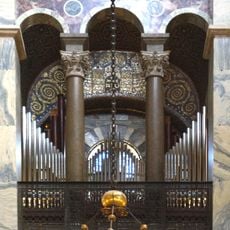
The name Aachen probably derives from the Latin Aquae Granni, after the thermal springs used since Roman times. The market sits on a ridge about 175 m above sea level, and the town's medieval layout still shapes the streets. The Gothic choir hall added to Charlemagne's octagonal palace chapel in the second half of the 14th century is the cathedral's best-known feature.
The old town's edge follows the Alleenring, a ring of avenues laid along the former moat outside the medieval wall; between Marschiertor and Kaiserplatz the wall ran further east, roughly along Wallstraße, Schützenstraße, Gottfriedstraße and Martin-Luther-Straße. Inside, Jakobstraße climbs a ridge from about 200 m at the old town entrance down to 175 m at the market, then the ground falls away on all sides. The lowest point, near Kaiserplatz, is about 159 m; the highest, the hill of the Lange Turm, 204 m. Part of the Johannisbach has run open again since 1999, in a channel from Lindenplatz along Annuntiatenbach and Augustinerbach to Pontstraße.
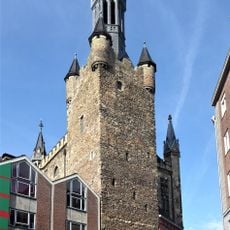
The old town's highest point, at 204 m above sea level, is the hill crowned by the Lange Turm; the lowest, around 159 m, lies near Kaiserplatz. Since 1999 part of the Johannisbach has run uncovered in a channel from Lindenplatz along Annuntiatenbach and Augustinerbach to Pontstraße.
The community of curious travelers
AroundUs brings together thousands of curated places, local tips, and hidden gems, enriched daily by 93,699 contributors worldwide.