Pala d’oro, Medieval gold altar decoration in Aachen Cathedral, Germany
The Pala d'oro is the gold antependium on the front of the main altar of Aachen Cathedral: seventeen repoussé panels of thin gold foil (999.98‰ purity) mounted on wooden boards. A central mandorla shows Christ enthroned, flanked by Mary and the Archangel Michael spearing a dragon, with four 11 cm evangelist medallions at the frame crossings and ten Passion and Resurrection scenes around them. The panels measure about 22.5–23 by 25.5–26 cm; the present 4 × 3 arrangement and frame date from the 19th century.
The Pala d'oro is dated to the first quarter of the eleventh century and is attributed to a donation by the Saxon imperial house. It is a masterpiece of Ottonian goldsmithing, probably made in the same workshop as the Basel Antependium. It is one of the few metal altar frontals from the early Middle Ages to survive.
The central composition shows Christ flanked by Mary and the Archangel Michael, with evangelist symbols and scenes from the Passion story arranged in a formal pattern. This sacred layout guides the viewer's eye through the theological narrative displayed in gold.
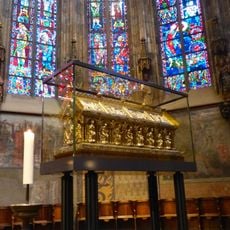
The work is displayed at the main altar within the Gothic choir section of the cathedral and is viewable during regular visiting hours. Visitors should allow time to examine the fine details and composition of each plate closely.
The frame visitors see is not medieval: Canon Franz Bock persuaded William I to fund a new frame by Aachen goldsmith August Witte, presented in 1872 for the 25th anniversary of the Karlsverein. The reliefs were then rearranged in reading order, so the present sequence need not be the original one.
The community of curious travelers
AroundUs brings together thousands of curated places, local tips, and hidden gems, enriched daily by 92,639 contributors worldwide.