Marienschrein, Medieval gold reliquary in Aachen Cathedral, Germany
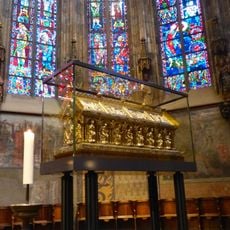
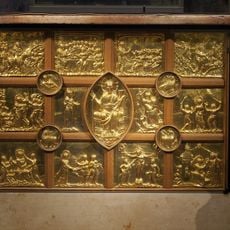
Marienschrein is a medieval reliquary in Aachen Cathedral measuring 184 centimeters long, 54 centimeters wide, and 95 centimeters high. The shrine displays intricate goldsmith work and features roughly one thousand precious stones set into its elaborate golden surface.
The chapter of St Mary's ordered the shrine around 1220, and it was completed in 1239. It was the last of the three great Rhenish reliquaries, after Cologne's Shrine of the Three Kings and Aachen's Karlsschrein. Two goldsmiths likely worked on it: an older one in the style of the Karlsschrein and a younger one with more plastic, Gothic figures.
The shrine's key ceremony is a public tradition: the lead-filled lock is smashed at the start of each Heiligtumsfahrt, and the sawn key halves are kept separately by the cathedral chapter and the city. Since 1888, donated locks have carried decorative motifs, including the 1986 Katholikentag logo and a 2014 lock shaped after the Nebra sky disc.
The shrine stands in a glass vitrine in the choir hall of Aachen Cathedral and can be viewed there during a visit; it is inspected annually and cleaned as needed. The relics themselves are shown only every seven years during the Aachen pilgrimage (Heiligtumsfahrt), most recently in 2014. The lock used for that pilgrimage is displayed in the cathedral treasury.
The key to the sealed lock is sawn in two by master goldsmiths: the head goes to the cathedral chapter, the bit to the city authorities, under the shared custody right known as Konkustodienrecht. At the start of each pilgrimage the lock is smashed open. Locks used since 1888 are displayed in the cathedral treasury; the one used after 2014 follows the design of the Nebra sky disc.
The community of curious travelers
AroundUs brings together thousands of curated places, local tips, and hidden gems, enriched daily by 93,849 contributors worldwide.