Couven-Museum, Furniture museum in Aachen, Germany.
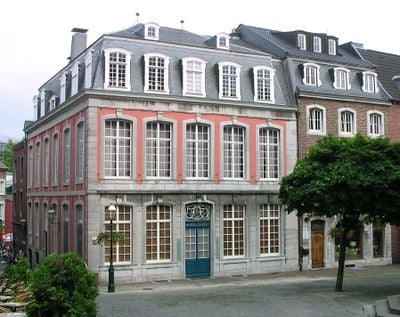
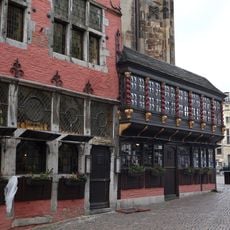
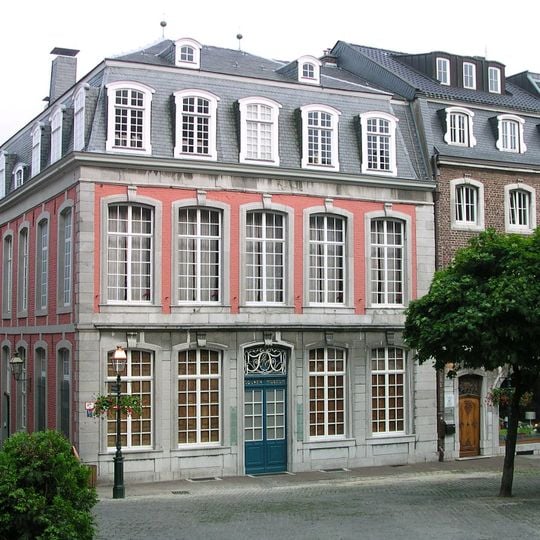
The Couven Museum occupies Haus Monheim at Hühnermarkt, a corner building with a grey slate mansard roof and dormer windows. Its upper storey is painted salmon red with light grey stone trim around tall multi-paned windows; the grey stone ground floor has a blue double door in a round-arched opening and a smaller wooden door. The facade inscription reads "COUVEN-MUSEUM". Inside, period rooms show 18th- and early 19th-century domestic culture, including a pharmacy room recalling the Adler-Apotheke that operated here from 1663 to 1878.
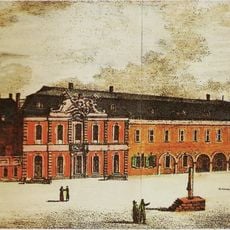
The museum opened on 1 July 1929 in Haus Fey, a house rebuilt by Jakob Couven in 1765–1767, on the initiative of Felix Kuetgens, director of Aachen's municipal museums. Haus Fey burned out after a bombing on 14 July 1943. In 1953 the city bought Haus Monheim, Couven's only surviving building, and the museum reopened there on 10 May 1958.
The displays show how people lived and furnished their homes across different periods, with pieces and rooms in styles ranging from Empire to Biedermeier. Visitors can observe how taste and domestic life changed from the mid-1700s through the 1800s.
The museum occupies Haus Monheim at Hühnermarkt, beside the town hall and cathedral, and is part of the Route Charlemagne. Its rooms are spread over three floors, with the pharmacy and tiled rooms on the ground floor and the Feestzaal on the first. Since 2003 a glass roof covers the inner courtyard.
The ground-floor room recalls the Adler-Apotheke, which operated in Haus Monheim from 1663 to 1878. It is a reconstruction rather than a surviving interior, fitted out when the museum reopened in 1958. Look for the open fireplace and water pump in the adjoining kitchen.
The community of curious travelers
AroundUs brings together thousands of curated places, local tips, and hidden gems, enriched daily by 93,132 contributors worldwide.