Wieland-Denkmal, Literary monument at Wielandplatz, Weimar, Germany.
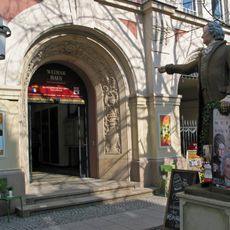
The Wieland Monument is a classicist, over-life-size bronze standing figure of the poet Christoph Martin Wieland on Wielandplatz in Weimar, cast by Ferdinand Miller in Munich after a design by Hanns Gasser. Wieland wears a frock coat, his head slightly tilted in a storytelling gesture, and holds a scroll inscribed with his main work, Oberon, in his left hand. The figure stands about 50 years old on a highly polished granite base with a bronze plaque.
The monument was created by sculptor Hanns Gasser and cast in bronze by Ferdinand Miller in Munich. It was unveiled on 4 September 1857, the centenary of Carl August's birth; the Wieland fountain was inaugurated the same year. King Ludwig I of Bavaria supplied the bronze in 1848, taken from Ottoman cannons captured at the Battle of Navarino.
The statue holds a scroll inscribed with Oberon, Wieland's best-known epic poem, in his left hand. The head is tilted slightly in a storytelling gesture, and the stance follows the classical motif of ponderation. The polished granite base carries a bronze plaque with an inscription.
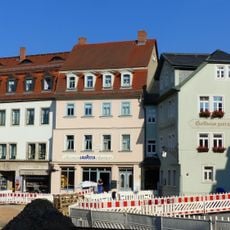
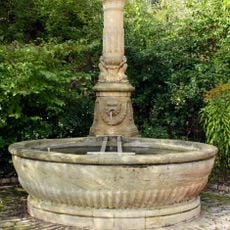
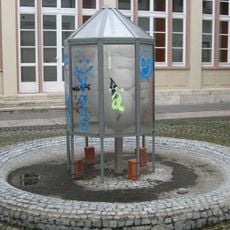
The monument stands on Wielandplatz, where Marienstrasse and Frauenstrasse meet. The Wielandbrunnen fountain, inaugurated in the same year as the statue, is part of the same square, so both can be seen in one stop. The bronze stands on a polished granite base and is listed as an individual cultural monument of Weimar.
The bronze came from Ottoman cannons captured at the Battle of Navarino; King Ludwig I of Bavaria provided the material in 1848. In 1918 the statue was the only one in Weimar slated for melting down to make cannon barrels, but the plan was never carried out.
The community of curious travelers
AroundUs brings together thousands of curated places, local tips, and hidden gems, enriched daily by 93,800 contributors worldwide.