Goethe House, Writer's house museum on the Frauenplan in Weimar, Germany
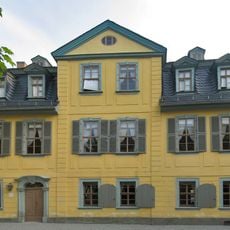
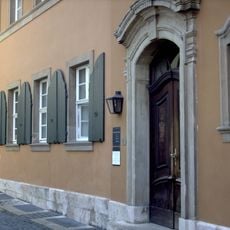
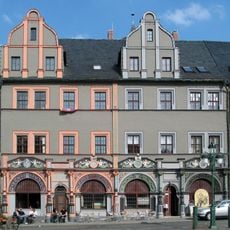
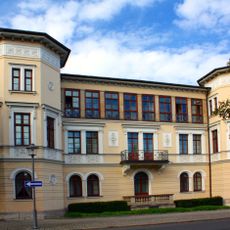
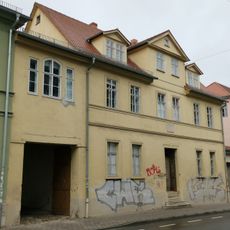
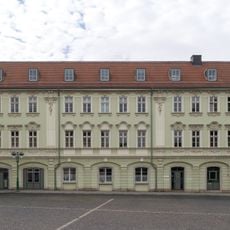
The Goethe House at Frauenplan is a two-story building with a pale yellow facade, grey stone pilasters and a dark mansard roof with dormer windows. Above the arched wooden door on the left, an inscription reads "GOETHEHAUS". The central entrance with a triangular pediment and stone steps is closed; museum access is on the left. Inside, the front house holds the Yellow Room, Juno Room and Urbino Room, while the rear house contains Goethe's study and bedroom.
Georg Caspar Helmershausen built the house between 1707 and 1709, and it was largely rented out at first. Goethe moved into the western half in 1782; in 1792 Duke Carl August bought it for him as a service residence, and ownership was formally transferred on 12 January 1807. Between 1792 and 1795 the house was rebuilt in Neoclassical style, with an inner staircase modelled on Italian examples. Goethe lived here until his death in 1832.
The house takes its name from its most famous resident and shows how a wealthy family lived in Weimar when the city was a center of German literature and thought. Visitors can see how the rooms were used for work and social gatherings, revealing the place's importance to cultural life at the time.
The house is centrally located in Weimar and is easily accessible on foot, with adequate space for small groups and individual visitors. It is helpful to plan with enough time to explore all the rooms and their contents without rushing.
The adjacent grounds contain a historic garden with its original layout and a pavilion that once housed a specialized collection of natural objects. This area reveals how the resident studied and collected aspects of nature, showing a lesser-known interest alongside his literary work.
The community of curious travelers
AroundUs brings together thousands of curated places, local tips, and hidden gems, enriched daily by 93,013 contributors worldwide.