Schauburg, Demolished cinema facade site in Schwerin, Germany
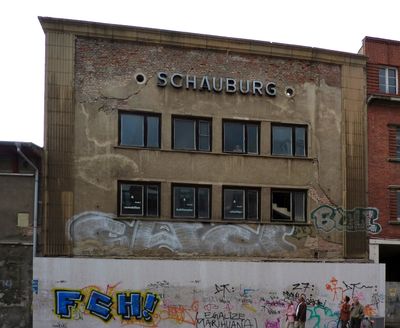
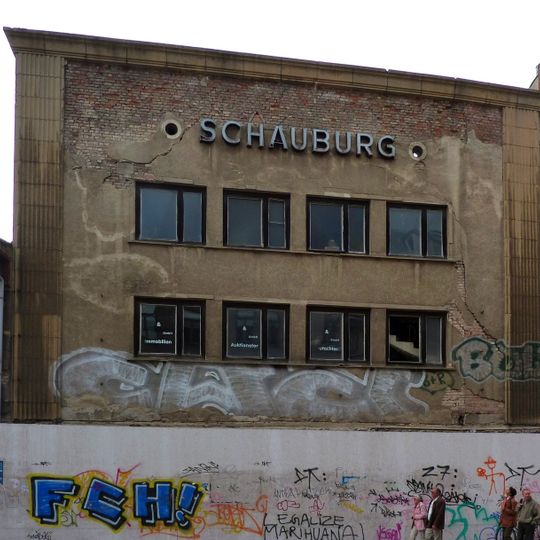
The Schauburg is a former cinema at Mecklenburgstraße 53 in Schwerin, opened in 1912 as the Lichtkunst-Palast. Its facade, reworked in 1928 by architect Erich Bentrup in an expressionist style, shows weathered tan stucco with patches of red brick, especially near the top. Metal letters reading "SCHAUBURG" sit above two round windows, and graffiti covers the base.
The building began in 1878 as Walhalla Theatre and transformed in 1912 into one of Mecklenburg's first dedicated cinemas called Lichtkunst-Palast. This conversion marks how entertainment evolved in the region.
The name Schauburg, adopted in 1928, replaced Apollo-Lichtspiele. In 1963 queues of about 200 metres, three to four rows deep, stretched two streets to the Stadthallen at today's Marienplatz for the Western The Magnificent Seven, the GDR's most-watched film of that year with 3,118,309 visitors; it was withdrawn after a short run.
The building no longer operates as a cinema, but the facade is publicly visible and can be viewed from outside. It is worth taking time to look closely at the ground floor and its distinctive architectural features.
In 1958 architect Hermann Struve added an undulating awning to the ground floor, a striking feature that was not removed until 2007. This element was a visible part of the building's appearance for decades.
The community of curious travelers
AroundUs brings together thousands of curated places, local tips, and hidden gems, enriched daily by 93,726 contributors worldwide.