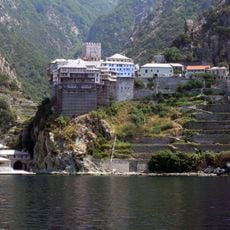
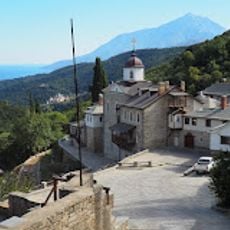
Konstamonitou monastery, Orthodox monastery in Mount Athos, Greece
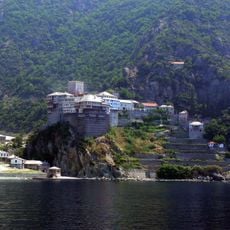
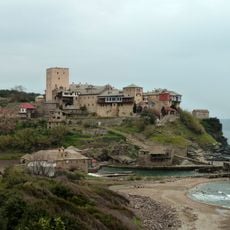
Konstamonitou is a Byzantine monastery within the monastic community of Mount Athos, Greece. The complex includes multiple chapels and a library containing medieval religious manuscripts preserved within the fortified compound.
Founded in the 11th century, Konstamonitou ranks twentieth and last in the hierarchy of Athonite monasteries. Tradition credits Emperor Constantine and his son Constans, while others name a monk from Kastamon in Paphlagonia. After a fire in the 1420s it was restored by the Serbian magnate Radič, and from 1818 abbot Chrysanthos rebuilt the east wing with funds from Ali Pasha, arranged by kyra Vasiliki.
The monastery's name is linked to Kastamon in Paphlagonia or to the Byzantine Kastamonites family, though tradition also credits Constantine the Great and his son Constans. Its main church keeps the icon of the Theotokos Antiphonitria, said to have worked a miracle here in 1020, and a silver-gilt Gospel cover made in Epirus in 1820, a gift of kyra Vasiliki.
Access requires advance permission from the monastic authorities, as it is a sacred religious site with specific protocols. Expect traditional visiting hours and plan to dress modestly to respect the spiritual nature of the place.
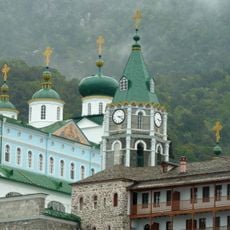
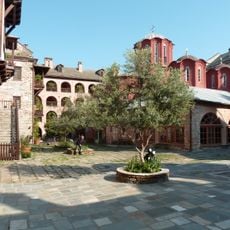
The main church, rebuilt in 1867, has eight lead-covered domes plus a larger central one, and its interior is largely un frescoed apart from a small central vault. Its walls instead hold many portable icons, including the Theotokos Antiphonitria, which tradition says worked a miracle here in 1020.
The community of curious travelers
AroundUs brings together thousands of curated places, local tips, and hidden gems, enriched daily by 94,367 contributors worldwide.