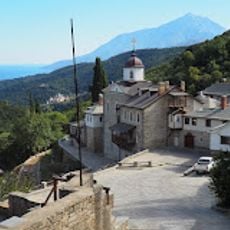
Hilandar, Orthodox monastery in Mount Athos, Greece.
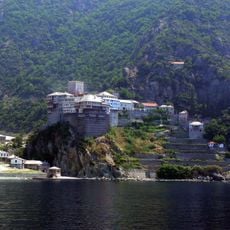
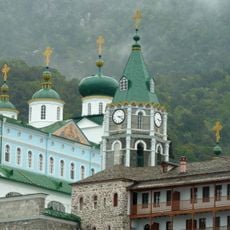
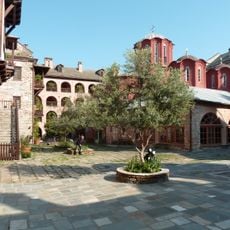
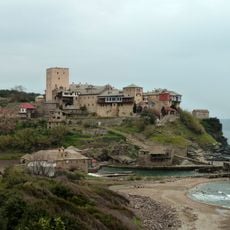
Hilandar is a Serbian Orthodox monastery in a wooded valley on Mount Athos, Greece, about 2.5 km from the Aegean. Its walls, up to 30 m high and roughly 140 m long, enclose a court about 75 m wide, so it reads as a medieval fortress. A square stone tower with a pyramidal roof rises near the centre, beside wings of pale masonry with rows of small windows and arched openings; cypresses stand in front of the church.
Hilandar was founded in 1198, when Byzantine Emperor Alexios III Angelos granted the old monastery of Helandaris to the monk Simeon (formerly Grand Prince Stefan Nemanja) and his son Sava. King Stefan Uroš I fortified it in 1262, and King Milutin built a new Church of the Entry of the Theotokos around 1320. A fire in 2004 damaged much of the complex, which has since been restored.
The monastery's name likely comes from the Greek chelandion, a Byzantine transport ship whose captain was called helandaris. The Mother of God, through the icon of the Three Hands (Trojeručica), is considered the abbess of Hilandar. The icon, painted according to tradition by John of Damascus, was brought by Saint Sava from the Mar Saba monastery in Palestine. Grapes said to grow from Saint Simeon's tomb are sent to childless couples.
Only men may enter Mount Athos, and they need a diamonitirion permit that must be requested in advance. Walks between monasteries require sturdy shoes and stamina, as paths are often steep and rocky.
The monastery follows the Byzantine timekeeping system, where each day begins at sunset, which means clocks here run differently than anywhere else. This ancient method shapes the rhythm of daily prayer and monastic work.
The community of curious travelers
AroundUs brings together thousands of curated places, local tips, and hidden gems, enriched daily by 92,797 contributors worldwide.