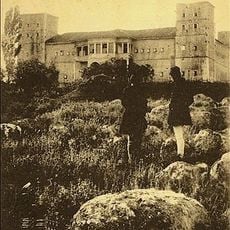
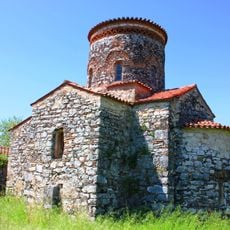
Church of the Parigoritissa, Byzantine church in Arta, Greece.
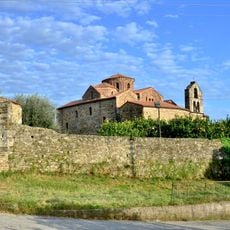
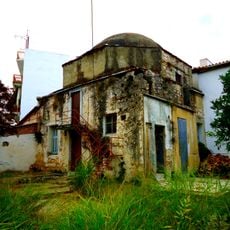
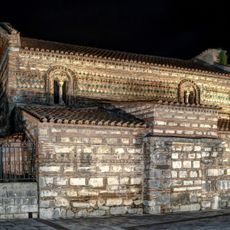
The Church of Parigoritissa is a Byzantine building with an octagonal plan and a central dome supported by eight piers. Four smaller domes sit at each corner, creating a distinctive silhouette when viewed from outside.
Begun around 1250 under Despot Michael II Komnenos Doukas, the church was damaged and rebuilt in 1290 by his son Nikephoros I and Nikephoros's second wife Anna Kantakouzene. Later bankrupt, it became a dependency of the Kato Panagia Monastery and is attested in 1578 as a female convent.
The name Parigoritissa means "Panagia of Consolation". The dome mosaic shows the Pantokrator with a halo 3.23 m across and a head 2.22 m wide, sized so that from the floor the proportions look normal. Frescoes survive in three layers: the monk Ananias in the sanctuary, 17th-century Cretan work, and 18th-century painting in the narthex.
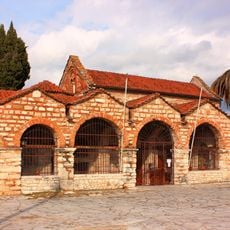
The church stands on the western slope of the Peranthis hill, and its lower exterior zone was hidden by a portico until 1865, which is why twelve pilasters still mark that line. Part of the building once housed the Archaeological Collection of Arta, but it is a working church, not a museum. Look up from the main entrance: the dome support is built so the Pantokrator mosaic stays visible from the door.
The dome rests on a bold two-tier system of paired columns and horizontal brackets, letting visitors see the Pantokrator mosaic from the main entrance. Tradition holds that when Faik Pasha seized Arta and tried to remove the columns for his mosque, the brackets broke and killed his men, and he never tried again.
The community of curious travelers
AroundUs brings together thousands of curated places, local tips, and hidden gems, enriched daily by 93,363 contributors worldwide.