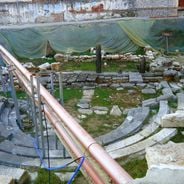
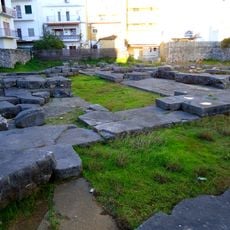
Small theatre of Ambracia, Greek theatre in Arta, Greece.
The small theatre of Ambracia is built into a slope, with a circular orchestra roughly 7 metres across at its base. Two radial stairways cut through the stone seating, which survives as three rows on each side and four in the central block, giving room for about 500 spectators. The koilon opens toward the plain once occupied by the ancient city.
The theatre was built between the late 4th and early 3rd century BC when Ambracia served as the capital under Pyrrhus' rule. This period marked the city as a major cultural hub and one of the region's most significant settlements.
The pebble-mosaic floors found beneath the theatre are made of small river stones set in mortar, not frescoes or mosaics of cut tesserae. Their scenes with Eros figures, swans and dolphins are a technique the Ambraciots also used in their houses, and they are among the finds that make the site worth a close look at the ground.
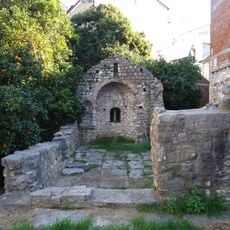
The site is marked by archaeological excavations where remains are partially uncovered and visible on the ground. Wear suitable footwear when visiting as the terrain is uneven with rocks of varying heights throughout the area.
The theatre's seating was cut into the natural slope rather than built up from level ground, and its small size has been linked to the city's reduced population in the Hellenistic period. Look for the curved retaining wall that holds the upper rows in place.
The community of curious travelers
AroundUs brings together thousands of curated places, local tips, and hidden gems, enriched daily by 93,011 contributors worldwide.