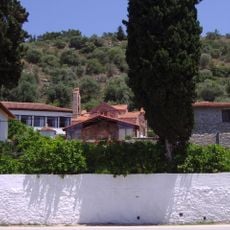
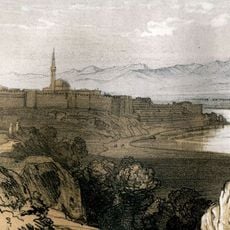
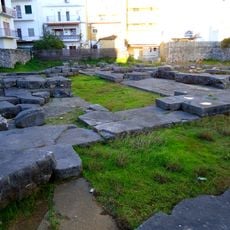
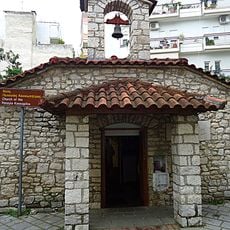
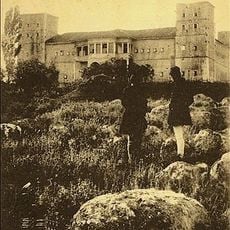
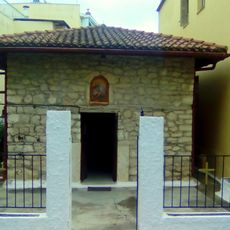
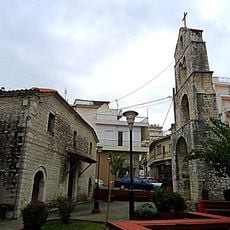
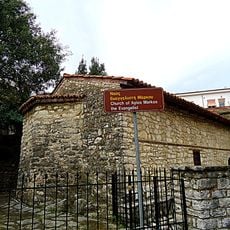
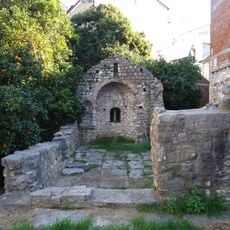
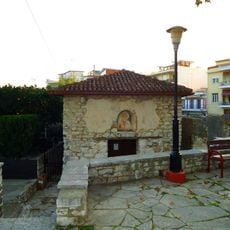
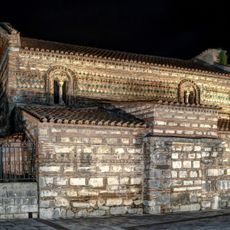
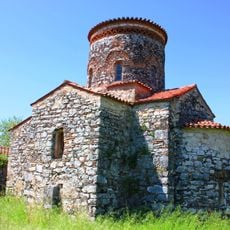
Vlacherna Monastery, Byzantine monastery in Artaion Municipality, Greece
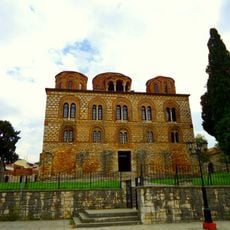
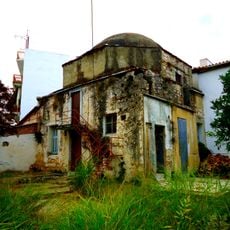
The Vlacherna Monastery is a three-aisled vaulted basilica with three domes, rebuilt in the early 13th century on the site of a late 9th- or early 10th-century wooden-roofed basilica. Its aisles have unequal widths and are separated by colonnades; the central aisle rises higher, and the eastern facade shows the apse of the earlier phase embedded in later masonry.
A late 9th- or early 10th-century wooden-roofed basilica with a three-part sanctuary was rebuilt in the early 13th century as a three-aisled vaulted basilica, then given three domes and a north-aisle furnace-like structure by mid-century. A narthex followed in the late 13th century. It served as the burial church of the Komnenos-Doukas rulers of the Despotate of Epirus.
The church was the burial place of the Komnenos-Doukas family, rulers of the Despotate of Epirus. A sarcophagus in the southwest bay of the nave is attributed to Despot Michael II Doukas. The frescoes place the Passion scenes in the southwest bay and post-Resurrection scenes in the northwest bay, framing the burials in an eschatological setting.
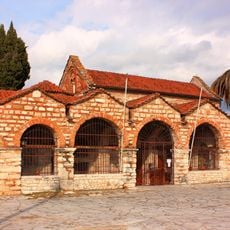
The church stands in the village of Vlacherna, just outside Arta. Of the original five entrances, only the central one in the west wall is still open, so enter from the west. The frescoes were uncovered in 1975-1977 and cleaning is still unfinished, so some painted surfaces may be covered or under work.
The frescoes were hidden under later lime plaster and only came to light in 1975–1977 during conservation work; study and cleaning of the revealed paintings is still unfinished. The south-west compartment of the nave holds a sarcophagus probably belonging to the despot Michael II Doukas.
The community of curious travelers
AroundUs brings together thousands of curated places, local tips, and hidden gems, enriched daily by 92,820 contributors worldwide.