Ship procession fresco, Bronze Age wall painting in Akrotiri, Greece
The Ship Procession Fresco is a miniature frieze 3.90 m long and 0.44 m high, painted between about 1650 and 1500 BC and set in niches above a doorway on the southeast wall of Room 5, an upper-floor ceremonial room of the West House at Akrotiri. It shows 14 ships and boats, seven of them large, moving from left to right: one square-rigged sailer, the rest rowed by about 20 paddlers, with stern cabins and, on two ships, masts with rigging.
The fresco was painted between about 1650 and 1500 BCE and was sealed under the ash of the Minoan eruption of Thera in the 17th or 16th century BCE. Its fragments were found in autumn 1972 during excavations at Akrotiri led by Spyridon Marinatos, who died at the site in 1974. The pieces had fallen from the wall of Room 5 in the West House and were taken to Athens for restoration.
The procession of ships painted across the walls suggests that sea voyages were a celebrated part of life for the people of Akrotiri. The dolphins leaping alongside the vessels add a sense of festivity to the scene, hinting at a culture that saw the sea as something worth honoring.
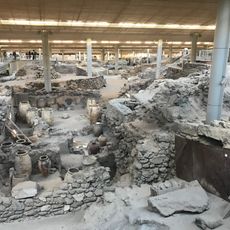
The fresco is not on public display: it is held in the depot of the National Archaeological Museum in Athens, so it cannot be seen by visitors. The reconstructed frieze measures 3.90 m by 0.44 m. To see the West House rooms where it hung, go to the Akrotiri excavation site on Santorini.
The frieze shows 14 ships, seven of them large: one under a square sail, the others rowed by about 20 paddlers facing the viewer. On one ship objects hang from the rigging, perhaps marking it as the fleet's flagship; its hull is painted with lions and dolphins, while the sailing ship's hull carries doves.
The community of curious travelers
AroundUs brings together thousands of curated places, local tips, and hidden gems, enriched daily by 92,820 contributors worldwide.