Rouffignac Cave, Prehistoric cave in Dordogne, France
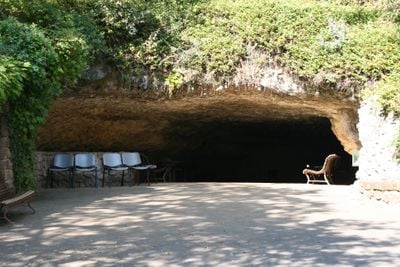
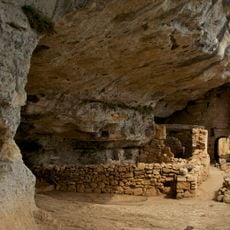
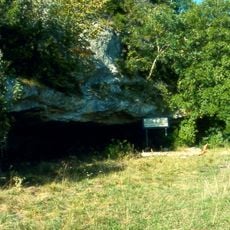
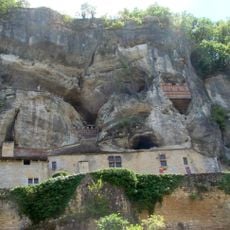
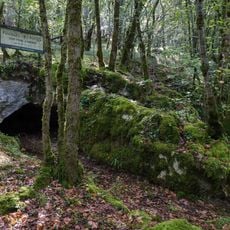
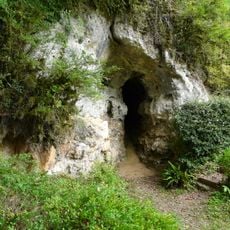
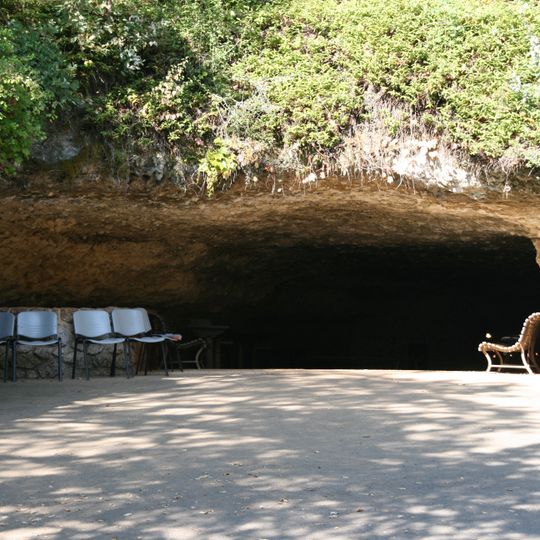
Rouffignac Cave is a limestone cave system in the Dordogne with more than 8 km of galleries, including a lower level reached by ten natural shafts. Visitors enter on an electric train that covers about 2 km into the interior. The walls bear black contour drawings and engravings, among them a mammoth with a curved tusk and a woolly rhinoceros with a long sweeping horn.
Mentioned in 1575 by François de Belleforest, the cave was known for centuries before its art was confirmed. In 1956 Louis-René Nougier and Romain Robert had the engravings and black drawings authenticated by a committee including Henri Breuil, Paolo Graziosi and Martin Almagro. It was classified a Monument historique in 1957 and opened to visitors in 1959.
The cave's walls and ceilings carry finger flutings, macaroni-like traces covering 500 m². Research by Jess Cooney and Leslie Van Gelder, announced in 2011, identified children as young as three among the artists who made many of these marks. The cave also holds 17 tectiform, house-like signs and 6 serpentiform signs.
Visitors travel through the cave on a small electric train, making it easy to view the artworks without strenuous walking. Sturdy shoes and a light jacket are advisable, as the underground temperature remains cool throughout the year.
The cave has no handprints. Its walls carry finger flutings, soft grooves traced in the clay, covering about 500 m². In 2011 Jess Cooney and Leslie Van Gelder identified many of these traces as the work of children as young as three, who also helped shape the tectiform signs.
The community of curious travelers
AroundUs brings together thousands of curated places, local tips, and hidden gems, enriched daily by 94,224 contributors worldwide.