Pic du Midi de Bigorre, Mountain peak and observatory in Hautes-Pyrénées, France.
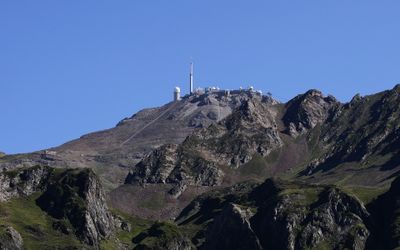
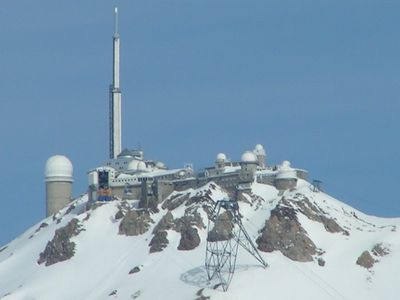
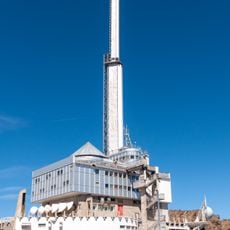
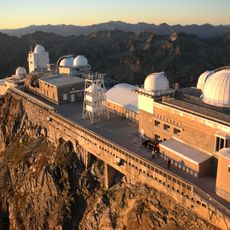
Pic du Midi de Bigorre is a 2877 meter (9439 feet) mountain in the French Pyrenees, known for its crystalline schist observatory complex at the top. The buildings up there house several telescopes and research facilities dedicated to studying celestial bodies.
The Ramond Society built an observatory up here in 1878, which soon became an important site for celestial observations. In 1909, researchers used a movable mirror telescope to disprove the then-popular theory about artificial canals on Mars.
The name comes from the Occitan 'midi', meaning south, and may follow an Alpine tradition of naming peaks south of their main observation point. The summit was earlier called 'montagne d'Arizes', a toponym meaning water, after the valley below. It became 'pic de Midi de Bagnères', then 'pic de Midi de Bigorre' in the late 19th century.
A cable car takes visitors from La Mongie to the top in about fifteen minutes. Once up there, you should bring warm clothing, as the temperature can remain cool even in summer and the wind often blows strongly.
The 2-metre Bernard Lyot Telescope, installed in 1980, is France's largest telescope; it stands on a 28-metre column set off to the side so wind turbulence would not disturb the other instruments. The summit also carries a coronagraph used to study the solar corona, and the 0.60-metre T60 telescope has been run by amateur astronomers since 1982.
The community of curious travelers
AroundUs brings together thousands of curated places, local tips, and hidden gems, enriched daily by 93,374 contributors worldwide.