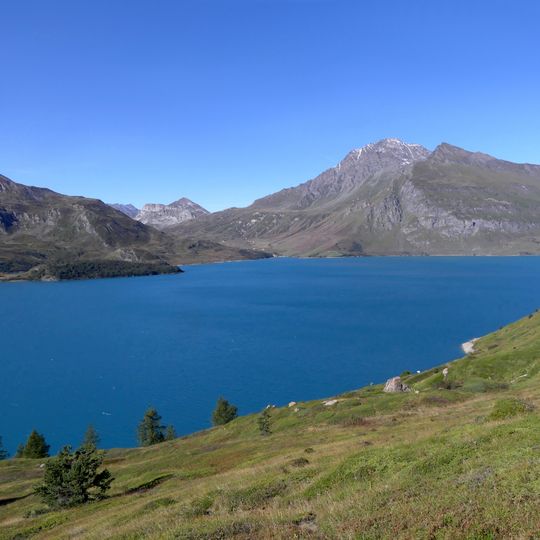
Mont Cenis Lake, Reservoir in Val-Cenis, France
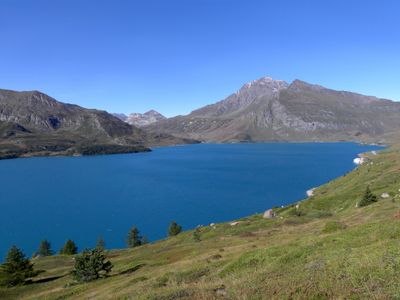
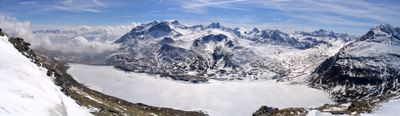
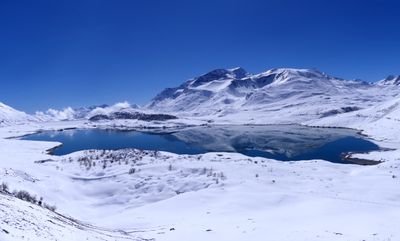
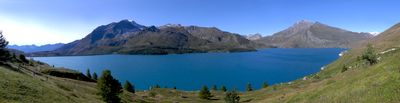
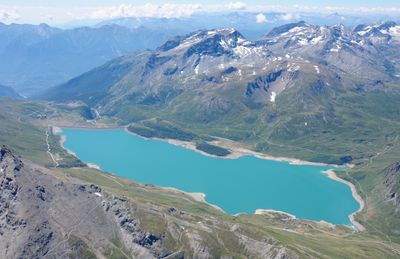
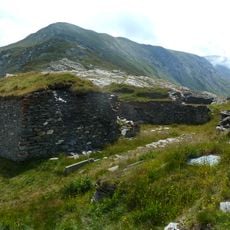
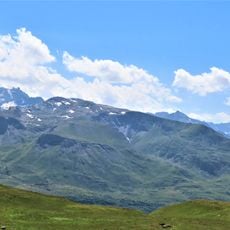
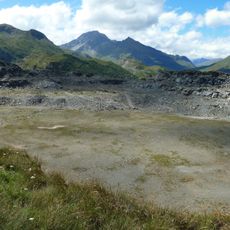
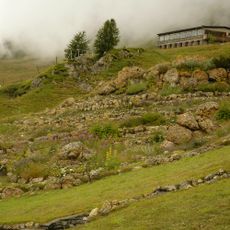
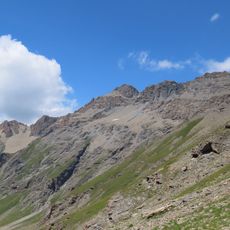
Mont Cenis Lake is a large reservoir in the French Alps at 1974 meters elevation. The water extends across almost seven square kilometers and is framed by the surrounding peaks of the Mont Cenis massif.
The natural Lac de Tullia once occupied the site; a first retaining dam was built in 1921. EDF built the present earth-fill dam between 1962 and 1969, flooding the hospice, its priory and the village of Grand-Croix. The 1947 Treaty of Paris moved the col and the combe from Italy to France, restoring them to the Savoyard communes of the Maurienne.
The pass above the lake was the busiest medieval crossing between Lyon, Turin and Milan, preferred over Montgenèvre and the higher Petit-Saint-Bernard. The chapel Notre-Dame-de-l'Assomption, a concrete pyramid built by EDF and consecrated on 21 July 1968 by Archbishop André Bontems, replaced the submerged priory and houses the museum "Le Mont-Cenis, porte millénaire des Alpes".
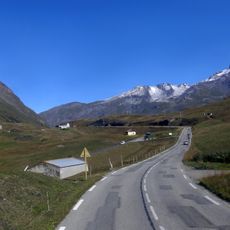
The lake lies at 1,974 m on the Italian side of the Mont Cenis pass, reached by road from Lanslebourg-Mont-Cenis in the Maurienne. The dam crest is 1,500 m long and 115 m high; the water is held at maximum level at that altitude. The reservoir feeds the Venaus plant in Italy through a 1,355 m drop and the Villarodin-Bourget plant in France through an 18 km tunnel.
The earthfill dam, 1,500 m long, 115 m high and 550 m thick at its base, holds back 320 million m³. EDF reused experience from Serre-Ponçon, where a clay core seals a mass of 15 million m³ of earth, against 14 million there. Rising water submerged the hospice, its priory and the village of Grand-Croix.
The community of curious travelers
AroundUs brings together thousands of curated places, local tips, and hidden gems, enriched daily by 93,409 contributors worldwide.