Chest opened
+${chestReward.xp} XP
Explorer
NOUVEAU ×${chestReward.collectible.quantity}
tapez pour fermer

See the monuments around you in AR Open chests in the app

Around Us is built for your phone — point your camera at the streets and discover the monuments and places around you in augmented reality. Around Us is built for your phone — chests unlock when you walk, explore and capture nearby places.

•

Enable Location

We need your location to show you interesting places around you

Discover nearby places

Find interesting locations and hidden gems around you

Precise directions

Get accurate directions and distances to places

Your location is never shared with other users. It's only used when you tap the location button.

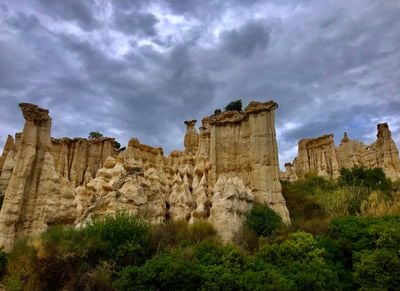
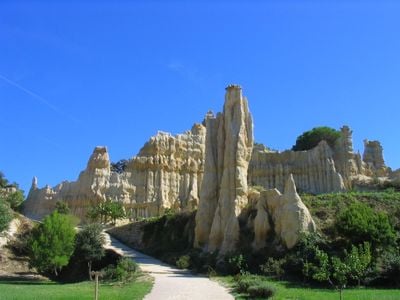
Les Orgues d’Ille-sur-Têt

Log in to your account

Start exploring — it's free

Trusted by 92,784 travelers worldwide

Continue with Google
Continue with Apple
or

We will send you a code to connect

By continuing, you accept our Terms and Conditions and our Privacy Policy

Check your inbox

We've sent a pincode in your inbox. Please enter the code below.

Les Orgues d’Ille-sur-Têt, Geological formation in Ille-sur-Têt, France.

The Orgues d'Ille-sur-Têt is a natural area where tall columns of soft rock in pale tones stand in irregular, sculptural forms shaped by erosion. Narrow paths wind between the vertical pillars, letting visitors see the layered sediment up close while low shrubs and grasses grow around the base.

The sedimentary rocks were deposited during the Pliocene, about four million years ago, when the Roussillon was a marine gulf and the Têt valley an arm of the sea. Gilbert-type deltas built the sandy and clayey layers that now form the cliffs. Erosion later carved them into hoodoos, and the name Orgues de la Sibylle was first recorded in 1947.

The name Orgues de la Sibylle, given in 1947 to the eastern part, compares the fluted columns to organ pipes; it also recalls the small Château de La Sibylle north of the site and the legend of Sibylle de Narbonne, killed by her husband André de Fenouillet, viscount of Ille, in the 14th century. The eastern sector was called Els Terrers, and a 1950 IGN map labels it Les Tuileries, after clay pits worked for tile kilns.

The site lies about 1 km north of Ille-sur-Têt, on the left bank of the Têt. From the D2 road climbing toward Montalba-le-Château, turn east toward the Saint-Clément de Reglella monastery; the car park and ticket office are about 500 m further. A second, separate group of formations stands west of the D2.

The columns keep changing through ongoing erosion, with some growing or shrinking a few centimeters each year. Fossil shells and marine organisms embedded in the sediment layers prove that this area once lay underwater as part of an ancient seabed.

The community of curious travelers

AroundUs brings together thousands of curated places, local tips, and hidden gems, enriched daily by 92,784 contributors worldwide.

Start exploring
Location
Elevation above the sea
185.3 m
Address
Chem. de Regleille, 66130 Ille-sur-Têt, France
Opening Hours
Monday-Sunday 09:30-18:00
Phone
GPS coordinates
42.68141,2.62188
Latest update
October 26, 2026 03:11
Natural areas in France: mountain lakes, limestone gorges, and forests

France features a notable variety of protected natural areas, showcasing the country’s geological and ecological richness. From Lake Allos in the Alpes-de-Haute-Provence to the underground rivers of Padirac in Dordogne, from the mountain ranges of Savoy to the limestone formations of the Ardèche...

Notable rock formations in France

France displays a range of geological formations shaped by millions of years of natural processes. White chalk cliffs mark the northern coast, including the cliffs of Étretat and the rock of Mont Saint-Michel in Normandy. In southern regions, deep limestone gorges cut through the landscape, while...

Occitanie: following the paths of the Cathar castles and limestone gorges

In Occitanie, medieval castles sit near stone villages, and the rocky landscapes are shaped by water.

Rock formations and hoodoos for Instagram photos

Rock pillars and spires shaped by erosion stand as natural monuments across various locations worldwide. These geological structures, known as hoodoos, display different colors and shapes based on their mineral composition and environmental conditions. From the red rocks of Utah to the limestone...

Between mountains and coast, the Pyrénées-Orientales tell their story

From the mountain of Canigou to the small fortified ports, the Pyrénées-Orientales have old castles, caves inside the mountains, and villages on the slopes.

What to see and do in Argelès-sur-Mer and its surroundings?

Argelès-sur-Mer sits wedged between the Mediterranean Sea and the Pyrenees Mountains, where you can move easily between beach days and exploring history. The town carries its past in several places: the Tour de la Massane, a watchtower built in the 1300s, rises high in the hills, while the Mémorial...

Reviews
Share your experience

No review yet

Discussions (2)
Start a discussion...
chpere59
chpere59 · Jul 16
chpere59
chpere59 · Jul 16
« Les Orgues d’Ille-sur-Têt - Geological formation in Ille-sur-Têt, France » is provided by Around Us (aroundus.com). Images and texts are derived from Wikimedia project under a Creative Commons license. You are allowed to copy, distribute, and modify copies of this page, under the conditions set by the license, as long as this note is clearly visible.

Discover hidden gems everywhere you go!

From secret cafés to breathtaking viewpoints, skip the crowded tourist spots and find places that match your style. Our app makes it easy with voice search, smart filtering, route optimization, and insider tips from travelers worldwide. Download now for the complete mobile experience.

Around Us App Screenshot
❝

A unique approach to discovering new places❞

— Le Figaro

❝

All the places worth exploring❞

— France Info

❝

A tailor-made excursion in just a few clicks❞

— 20 Minutes

Around Us
Travel Guide & Maps
Download

Send to your phone

QR Code
1

Open the camera app on your mobile.
2

Point at the QR code with your camera. A notification will appear.

3

Tap the notification to open the link.