San Peyre, Volcanic hill in Mandelieu-la-Napoule, France
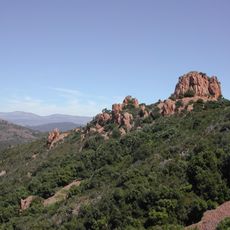
San Peyre is a volcanic summit near Mandelieu-la-Napoule rising approximately 131 meters above sea level, composed of rhyolite rock. A natural park covers the area with walking paths that wind through the site and reveal its geological features and vegetation.
In 1182 the lord of Villeneuve built the château d'Avignonnet and a chapel dedicated to Saint Peter, which gave the hill its name. The buildings passed to the Church of Antibes in 1241 and were restored in 1259, then destroyed in 1387 by troops of the viscount of Turenne. Remains of the keep and surrounding walls survive.
The name San Peyre comes from the chapel of Saint Peter built here in 1182. Guy de Maupassant met a hermit living in that summit chapel in the late 19th century and turned the encounter into his short story L'Ermite, published in Gil Blas in 1886. The hill was later nicknamed "the sacred mountain".
The site is accessible on foot with paths suited for different ability levels, so no special equipment is needed for most of the area. Plan a visit on clear days to enjoy views across the surrounding landscape.
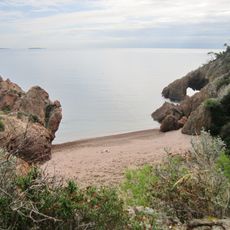
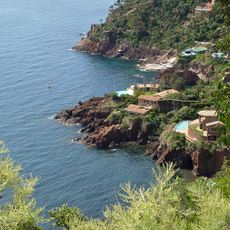
The rhyolite of San Peyre is amarante in colour, with millimetre-sized crystals of quartz and sanidine and a groundmass of orthose spherulites about 0.1 mm across. Under the microscope these spherulites line up, marking the rock's flow. The dome continues south as the Rochers des Pendus, a near-vertical dyke forming the coastal cliff from the Plage de la Raguette to la Rague.
The community of curious travelers
AroundUs brings together thousands of curated places, local tips, and hidden gems, enriched daily by 93,887 contributors worldwide.