Église Saint-Sauveur de Lille, Eclectic church in Lille-Centre, France
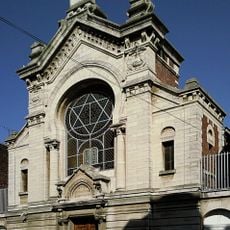
Église Saint-Sauveur is a three-aisled church in brick, sandstone and limestone, built on a Latin-cross plan with slate and zinc roofs. A dome covers the transept crossing, a cul-de-four closes the choir, and the bell tower stands behind the apse. The facade rises to a gable flanked by small square towers, with a deep round-arched recess above the gabled portal.
Construction took place between 1898 and 1902 under architect François-Joseph Delemer's direction, replacing a 14th-century Gothic structure that was destroyed in a fire. The rebuilding marked a significant transformation of the site.
The church keeps furnishings from the earlier Gothic building: five choir windows by Édouard Didron (1867), the high altar (1879–1882) and the altar of the Holy Angels (1884) carved by Modeste Verlinden. The Hazebrouck sculptor Gustave Pattein made the oak organ case, pulpit and confessionals, and a 1732 painting by the Lille painter Lamoral de Daudenarde hangs inside.
The church stands on rue Saint-Sauveur in the Lille-Centre district, served by the Mairie de Lille metro station. It has been closed for safety investigations since 2015 because of water infiltration, so the building can only be viewed from the street.
The four bells were cast in 1923 by Charles Wauthy of Douai and baptised on 28 January 1923. The bourdon, Hector-Pauline, weighs 3,600 kg; the others are Marie-Alexis (1,322 kg), Geneviève (993 kg) and Octavie-Victor-Pauline-Ferdinand (696 kg).
The community of curious travelers
AroundUs brings together thousands of curated places, local tips, and hidden gems, enriched daily by 92,933 contributors worldwide.