Église Saint-Hugues-de-Chartreuse, Mountain church and art museum in Saint-Pierre-de-Chartreuse, France.
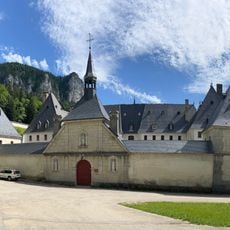
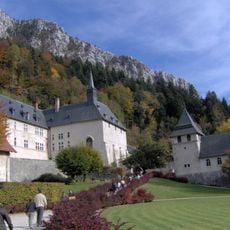
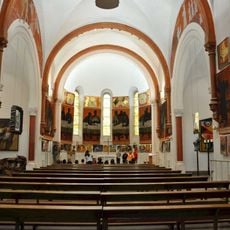
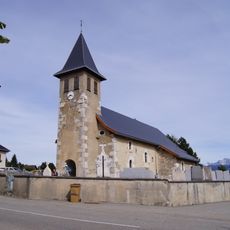
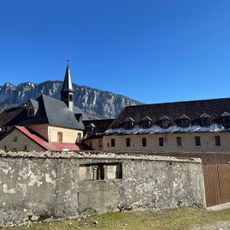
Église Saint-Hugues-de-Chartreuse is a neo-Romanesque church built in 1860 in the hamlet of Saint-Hugues-de-Chartreuse, in Saint-Pierre-de-Chartreuse. It has a square bell tower of light gray blocks topped by a dark slate spire, with three arched louvered openings, a round white clock and a gabled porch with pink double doors. Unlike tradition, it faces west, and its interior holds 111 sacred works by Arcabas.
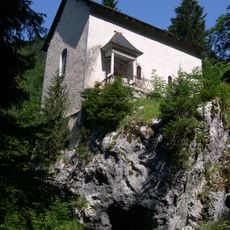
A chapel built around 1834 by a local family stood here first. On 1 June 1852 a decree of Louis Napoléon Bonaparte made Saint-Hugues a succursale parish covering fifteen hamlets. Deemed unsafe by 1874, the church was demolished from 21 March 1881; the Carthusians paid half of the reconstruction, finished in 1883 with the bell tower's spire and new belfry. In 1984 it was donated to the Isère department.
The church displays works by multiple artists engaging with religious subjects through different styles that coexist in the same space. Visitors can observe how traditional religious representations and contemporary interpretations stand side by side throughout the building.
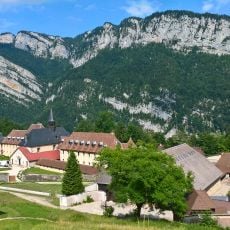
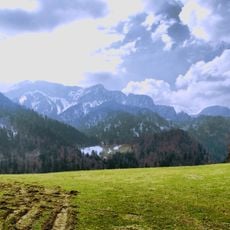
The church stands in the hamlet of Saint-Hugues-de-Chartreuse, within the Chartreuse Regional Nature Park, and is reached by road from Saint-Pierre-de-Chartreuse. It is not oriented to the east like most churches but to the west, so the facade and tower face the opposite direction from what tradition would suggest. The building belongs to the Département de l'Isère since a donation in 1984.
Each section of the church displays different phases of artistic development, allowing visitors to follow a chronological path through creative evolution. This visual journey lets you trace changes in style and technique across the decades.
The community of curious travelers
AroundUs brings together thousands of curated places, local tips, and hidden gems, enriched daily by 94,661 contributors worldwide.