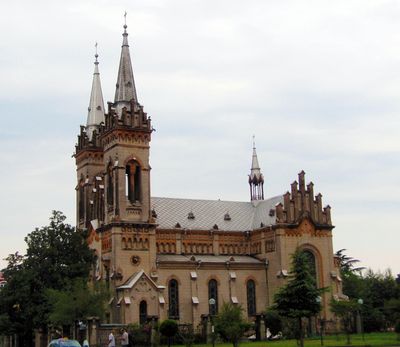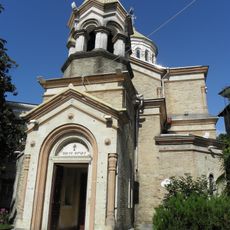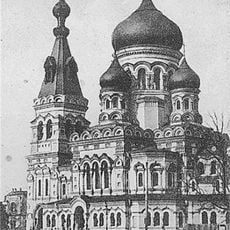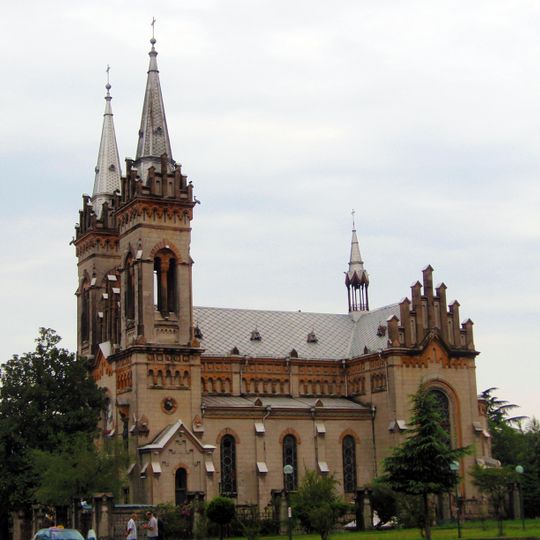
Batumi Cathedral of the Mother of God, Gothic Revival cathedral in central Batumi, Georgia.
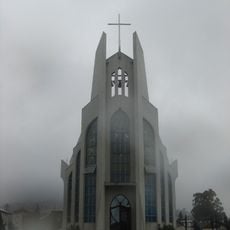
The Batumi Cathedral of the Mother of God is a Gothic Revival church in the center of Batumi, Georgia, recognizable by its two tall bell towers. The building has a three-part interior layout and an exterior with pentagonal projections that give it a sharp, angular outline against the city skyline.
The church was built between 1898 and 1903 for the Zubalashvili brothers, Georgian Catholic merchants, as a memorial to their mother Elisabed, who had asked for a Catholic church in Batumi. The Polish architect Aleksander Rogojski designed it, and Italian artists and architects worked on the construction, which cost 250,000 rubles. Closed in the 1930s under Soviet rule, it served as a high-voltage laboratory and later as an archive. In 1989 it was transferred to the Georgian Orthodox Church and consecrated by Patriarch Ilia II.
The cathedral was commissioned by the Zubalashvili brothers, Georgian Catholic merchants, and designed by the Polish architect Aleksander Rogojski. Since 1989 it has been the seat of the Georgian Orthodox bishop of Batumi and Lazeti. Its Orthodox interior has an iconostasis with gilded icons and frescoes of the life of the Virgin Mary, and the feasts dedicated to the Virgin Mary draw worshippers from across Adjara.
The cathedral sits in the center of Batumi and is easy to reach on foot from most parts of the old town. Visitors are expected to dress modestly, and it is easier to look around outside of service hours.
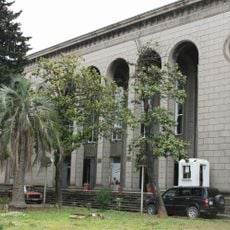
During the Soviet period, the building was used first as a high-voltage laboratory and then as an archive before returning to religious use. These two very different functions left the space largely intact structurally, which is why the Gothic Revival shell visitors see today survived so well.
The community of curious travelers
AroundUs brings together thousands of curated places, local tips, and hidden gems, enriched daily by 93,180 contributors worldwide.