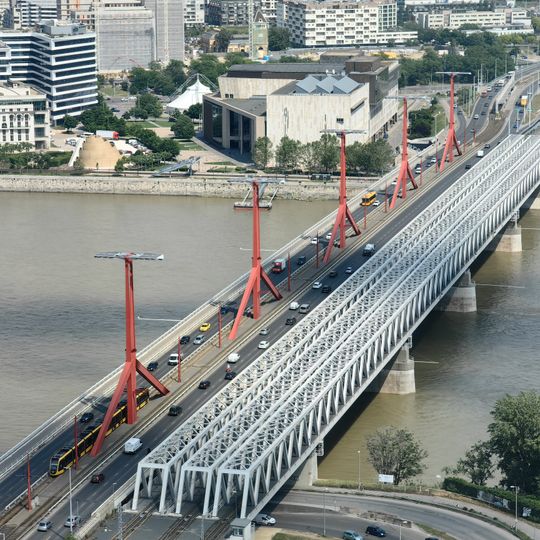
Connective Railway Bridge, Railway bridge in Budapest, Hungary
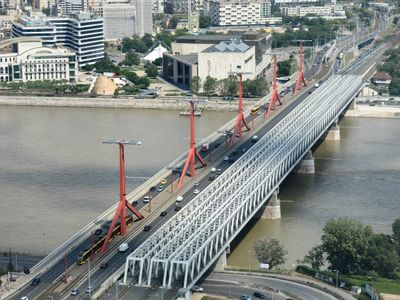
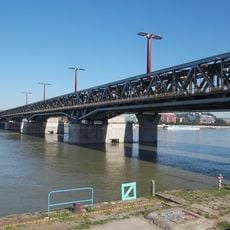
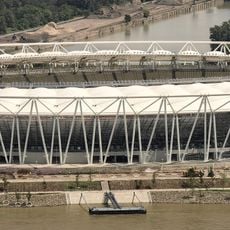
The Connective Railway Bridge (Összekötő vasúti híd) carries the southern Körvasút over the Danube just south of the Rákóczi Bridge, between Ferencváros and Kelenföld stations. Its four-span steel structure is 477 m long, with 393 m over the riverbed. The deck is a dense white lattice of crisscrossing trusses, and four tall red steel pylons shaped like inverted Ys rise from the deck and the river, with cables fanning down to the structure. The bridge rests on grey stone piers in the water.
The first bridge opened on 23 October 1877 between Ferencváros and Kelenföld, built by the French firms Filleul-Brohy and J.F. Cail & Cie. Its wrought-iron girders proved too weak for heavier traffic, so a steel arch bridge by MÁV engineer Ernő Kölber replaced it in November 1913. German troops blew it up on 31 December 1944; a one-track K-system bridge followed in 1946, then two permanent truss bridges in 1948 and 1953.
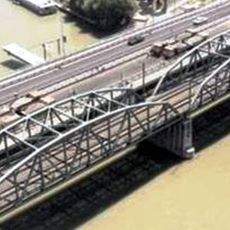
The bridge's name, Összekötő vasúti híd, means "connecting railway bridge", after the Körvasút line it carries; Hungarians often wrongly call it the Southern Connecting Railway Bridge. Its steel lattice girders, made in Belgium and France and assembled under János Feketeházy, are the ones a train passenger sees today.
Access to the bridge is limited to train passengers, so visitors can only view it from aboard a train. Walking across on foot is not permitted.
The 1946 temporary bridge was dismantled once the permanent spans opened, and its K-system elements were reused for the Újpest railway bridge, also blown up at the end of the war. The free space left on the piers is kept in reserve for renewals.
The community of curious travelers
AroundUs brings together thousands of curated places, local tips, and hidden gems, enriched daily by 92,746 contributors worldwide.