László Papp Budapest Sports Arena, Indoor sports arena in Budapest, Hungary
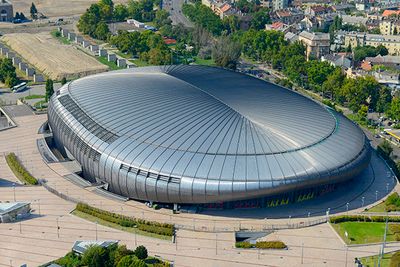
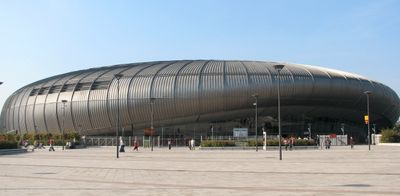
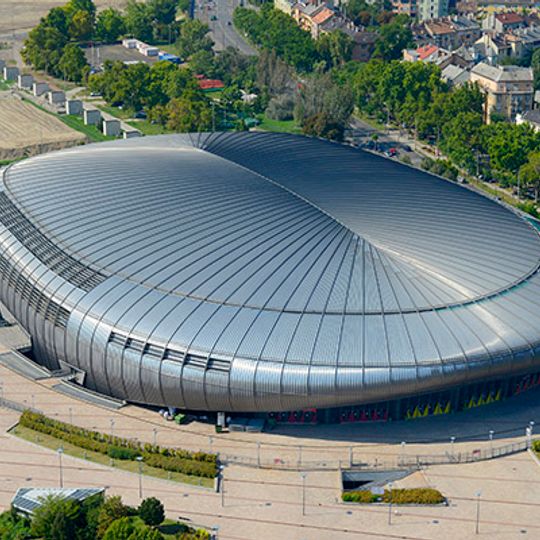
The László Papp Budapest Sports Arena is an oval hall with a broad, low dome clad in long, vertically ridged silver-grey metal panels that converge toward a central ridge. The roof overhangs a band of dark glazing and a recessed ground level, where red, yellow and green panels line the base. It stands on a granite-paved plaza of 15,000 m², Hungary's largest granite surface, with low hedges and thin poles.
The first Budapest Sportcsarnok, designed by István Kiss and modelled on Leningrad's Yubileyny hall, opened on 12 February 1982 and held 12,500 spectators. It burned down on 15 December 1999 during the Christmas market, probably from an electrical fault. Construction of the replacement began on 30 June 2001 to plans by György Skardelli, Péter Pottyondy and KÖZTI with Sport Concepts, and it was inaugurated on 13 March 2003. Since 28 May 2004 it bears the name of boxer László Papp.
The arena has carried László Papp's name since 28 May 2004; Papp was a three-time Olympic boxing champion who later became a coach and sports official. The building is nicknamed "the pebble" (kavics). Its opening on 14 March 2003 ended with Beethoven's Ninth Symphony, chosen to mark Hungary's forthcoming EU entry.
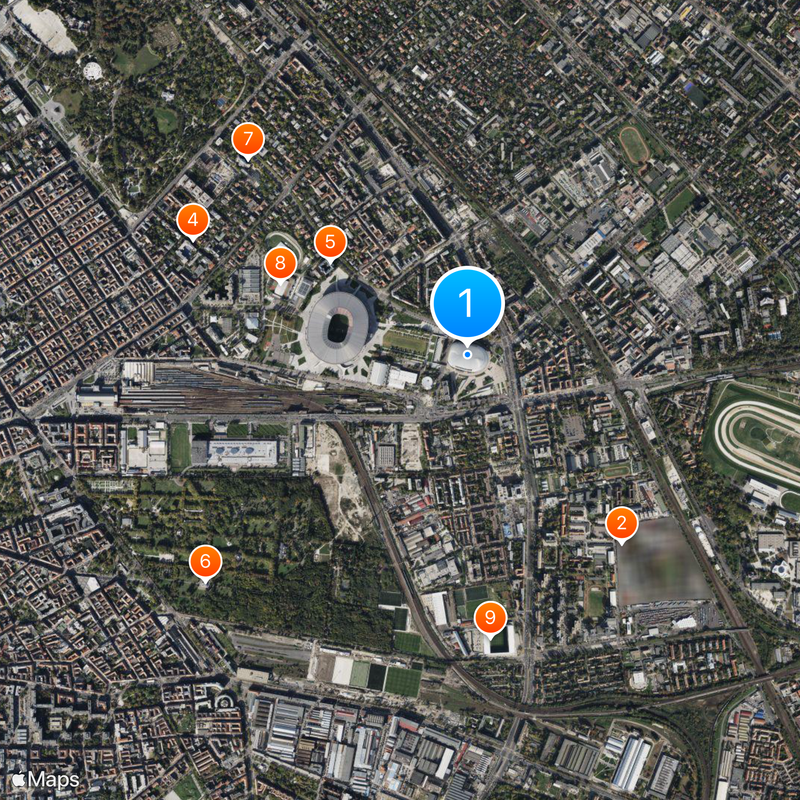
The venue is easily reached by public transit thanks to an underground bus station connection right at the entrance. Accessible entrances and a range of seating options from standard to VIP boxes make it convenient for different visitor needs.
The arena weighs about 200,000 tons, more than the Elisabeth and Liberty bridges combined, and its 15,000 m² pedestrian plaza is Hungary's largest granite surface. As a Hungarian first, three high-output water cannons stand in the auditorium, aimed at the area where the 1999 fire started.
The community of curious travelers
AroundUs brings together thousands of curated places, local tips, and hidden gems, enriched daily by 93,034 contributors worldwide.