Liberty Statue, Bronze monument on Gellért Hill, Budapest, Hungary.
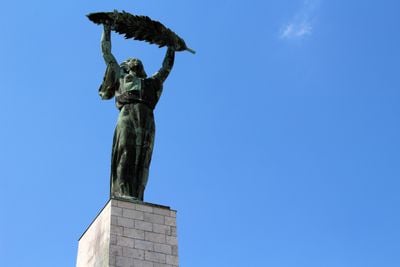
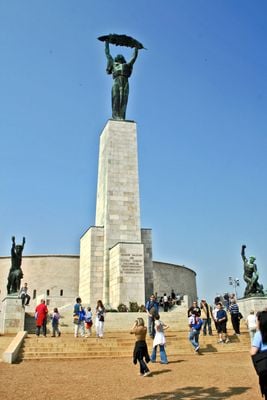
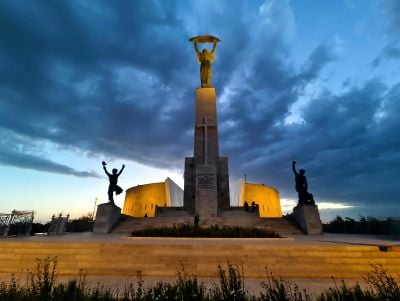
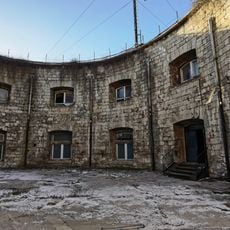
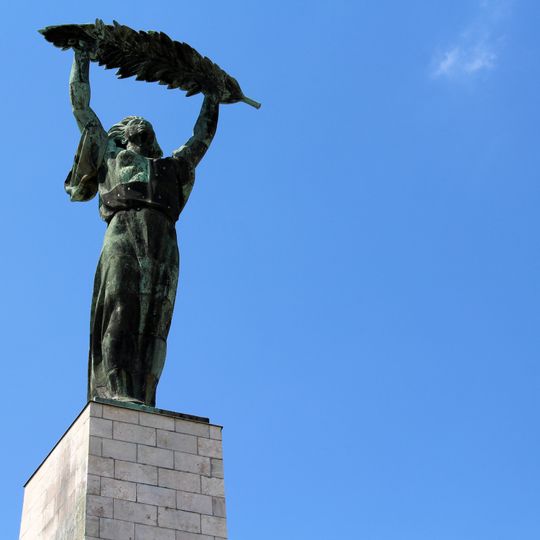
The Liberty Statue is a 14-metre bronze female figure holding a palm leaf above her head, standing on a 26-metre stone pedestal at the southeast bastion of the Citadella on Gellért Hill. Two smaller bronze figures with raised arms stand on curving walls at the base, and an inscribed panel on the pedestal ends with the line "ES BOLDOGUL ALTAT".
The monument was created in 1947 by sculptor Zsigmond Kisfaludi Strobl and held different meanings depending on the political situation. After 1989, its interpretation shifted from Soviet liberation to national independence, taking on new significance for Hungarian society.
The figure holds a palm leaf, a symbol of victory and peace added on Soviet instruction; Kisfaludi Strobl had originally designed the composition for a memorial to István Horthy, with a child in place of the leaf. The Hungarian name Szabadság-szobor means "Liberty Statue". Since 1989 the inscription reads "To the memory of those all who sacrificed their lives for the independence, freedom, and prosperity of Hungary", and the Russian text was removed.
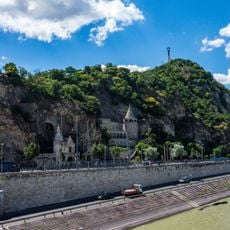
The site can be reached on foot via marked paths up Gellért Hill, though the walkways are quite steep in places. Wheelchair access is limited, and the best views occur in early morning or late afternoon light.
The model was Erzsébet Gaál, born in Viszák in 1917. She received no fee or recognition for posing, later worked as an X-ray assistant in Sopron, and died there in 1989. The sculptor Zsigmond Kisfaludi Strobl had originally designed the figure for a memorial to István Horthy, with a child in place of the palm leaf.
The community of curious travelers
AroundUs brings together thousands of curated places, local tips, and hidden gems, enriched daily by 92,632 contributors worldwide.