Ottoman bridge in Szolnok, Ottoman road bridge in Szolnok, Hungary.
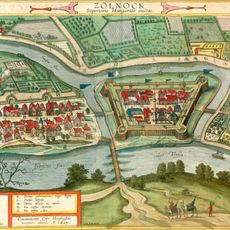
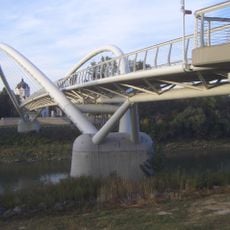
The Ottoman bridge in Szolnok was a roughly 110 m long timber crossing over the Tisza, built from oak logs floated down from the north. It ran about 70 m east of today's bridge, near the mouth of the Zagyva, joining the river's east bank at a right angle to the southwest bastion of Szolnok castle. Debrecen carpenters worked on it.
Built in 1562 on the orders of Güzeldzse Rüsztem, pasha of Buda, by Debrecen carpenters, it was the first permanent bridge over the Tisza and the first in Hungary. It was destroyed by 1685 during the liberation wars; later bridges followed at Szolnok in every century.
The bridge was built in 1562 by Debrecen carpenters under the order of Güzeldzse Rüsztem, the pasha of Buda. Its oak logs were floated down from the north, since local timber was unsuitable. In 2008 the Turkish ambassador Oya Tuzcuoglu opened an exhibition on the bridge at the Aba-Novák Cultural Centre.
The remains are oak piles, not foundations: vertical trunks 20–30 cm thick, with 10–30 cm showing near the bank and 40–60 cm farther out. They surface only at extreme low water; in 2003 the level stood 279 cm below average. Look on the left bank opposite the Zagyva mouth, about 70 m east of today's bridge.
The foundation became visible again during the drought of 2003, allowing researchers to document it properly for the first time. This discovery gave experts important insights into the original design and building methods used.
The community of curious travelers
AroundUs brings together thousands of curated places, local tips, and hidden gems, enriched daily by 93,480 contributors worldwide.