Szolnok Castle, Military fortress in Szolnok, Hungary.
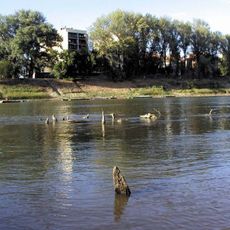
Szolnok Castle sits where the Tisza and Zagyva rivers meet, displaying the remnants of stone walls and defensive structures built for military control. The layout reflects a typical medieval Hungarian fortress designed to guard a critical river crossing.
An earthwork fort stood here from the Árpád dynasty. In 1550–51 Ferdinand I had it rebuilt as a palisade fort with a new town wall, partly planned by István Dobó, under Lőrinc Nyáry. On 2 September 1552 Ahmed Ali besieged it with 40,000 men; the mercenaries deserted on the night of 4 September and Nyáry was captured. The Ottomans held it until 1685, after which it was dismantled.
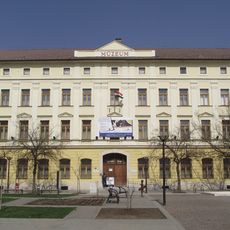
The Ottoman occupation from 1552 to 1685 left few visible traces: the minaret's base was turned into a decorative fountain, and the only Turkish codex made in Hungary was copied in Szolnok, describing Suleiman's campaigns. Pottery and tools from the Turkish era are displayed in the Damjanich János Museum.
No standing ruins remain: the castle was dismantled and its stones reused across Szolnok. The visible trace is the Zagyva branch dug in 1552, now where it meets the Tisza. The filled original bed survives as a small lake before the MÁV Hospital, known as the old moat's remnant.
The 1552 garrison of 1,400 was mostly Spanish, German and Czech, with only a small number of Hungarians. The Hungarian boatmen deserted first, swimming the Tisza on the night of 3 September; the mercenaries left the next night and the gate stood open by morning. Lőrinc Nyáry and fifty remaining men were captured.
The community of curious travelers
AroundUs brings together thousands of curated places, local tips, and hidden gems, enriched daily by 94,047 contributors worldwide.