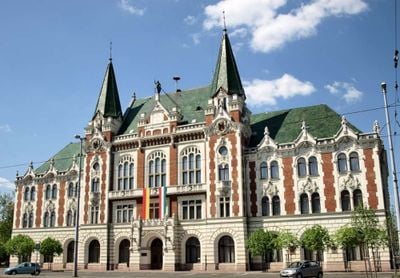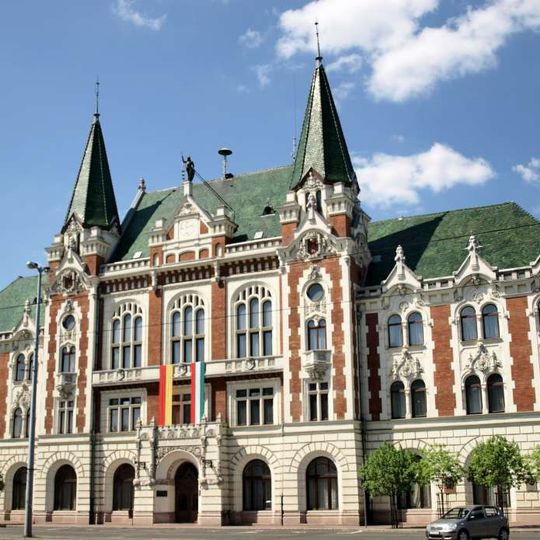
Újpest town hall, Municipal building in Budapest District IV, Hungary.
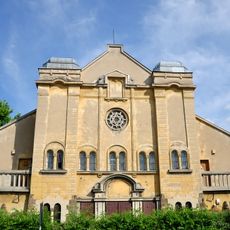
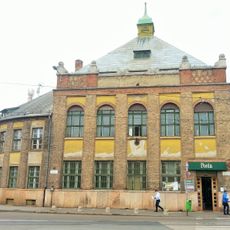
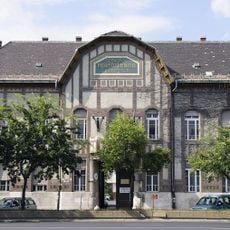
Újpest Town Hall is a two-storey eclectic-Secession building on Szent István tér, completed in 1900 to designs by Henrik Böhm and Ármin Hegedűs. Its main gable carries a statue of Roland, symbol of the town's municipal rights, and a balcony on the rear façade facing the square was built for addressing assemblies. The ground floor once housed rented shops, including a café.
Újpest's administration outgrew its offices at the corner of József and Attila streets, so in 1895 the town decided to build a two-storey town hall on Szent István tér. The 1898 competition was won by Henrik Böhm and Ármin Hegedűs; local builder Gyula Schreiber began work on 13 May 1899 with a budget of 200,000 Austro-Hungarian forints. The building was finished by summer 1900, altered to house the district court and a prison in the basement.
The ground floor was rented out as shops from the start; one of them was a café that appears in Mihály Babits's 1923 novel Kártyavár, set in Újpest. On the main gable stands a statue of Roland, a knight symbolising the town's right to self-government. A balcony on the rear side facing Szent István tér was built for addressing crowds gathered below.
The town hall is located at István út 14 and serves as the administrative center for District IV with various municipal offices and public services. When visiting, you can view the building's architectural details from outside or stop by to inquire about district administration matters.
The 1999 renovation left a red star inside the Budapest coat of arms on the main facade, a detail easy to miss. The building also kept a basement prison after the district court moved in during construction.
The community of curious travelers
AroundUs brings together thousands of curated places, local tips, and hidden gems, enriched daily by 92,644 contributors worldwide.