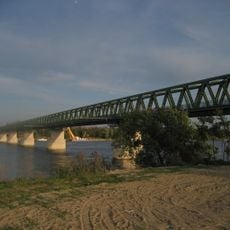
Tungsram strand, Public swimming facility in Újpest, Hungary
Tungsram strand, originally UTE Dunafürdő, is a closed open-air bath on the left bank of the Danube in Újpest, Budapest, beside the Megyeri csárda. Its 30,000 m² grounds held a 50 × 20 m competition pool with 700 seats, a 50 × 25 m pool for guests, a children's pool and a later mushroom-shaped pool. A boathouse stored 200 boats.
The strand opened on 10 July 1938 as UTE Dunafürdő, on a 900-metre filled bank created when the Danube channel was narrowed from 830 to 600 metres between 1921 and 1923. Its creation was driven by Lipót Aschner, director of Egyesült Izzó and head of UTE, who thereby saved the sports club from bankruptcy. The opening day featured an international swimming competition and a water polo match. It closed permanently on 26 August 2004.
The strand served as a gathering place for employees of the nearby Tungsram factory and their families seeking recreation and leisure time. This role made it an important social hub within the neighborhood where people from different backgrounds shared recreational spaces together.
The strand was a seasonal open-air facility on the left bank of the Danube, beside the Megyeri Csárda on Külső-Váci út; water from a well was heated in the machine room of the main building. Aschner paid out of his own pocket to extend the No. 87 tram line to the csárda in 1947, so the site could be reached by public transport. The grounds covered 30,000 m², with a 50 x 20 m competition pool ringed by 700 seats and a 50 x 25 m pool for guests.
The strand's site was created by river regulation between 1921 and 1923, when the Danube bed at the southern tip of Szentendre Island was narrowed from 830 to 600 metres. The resulting 900-metre-long filled strip on the Megyer bank became the beach in 1938.
The community of curious travelers
AroundUs brings together thousands of curated places, local tips, and hidden gems, enriched daily by 92,633 contributors worldwide.