Székesfehérvár Town Hall, Administrative building in Székesfehérvár, Hungary.
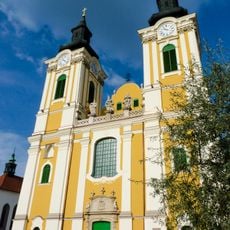
Székesfehérvár Town Hall is a three-part complex on Városház tér. The main building is a two-storey copf-style block with a tiled roof, a 12-axis main facade, and a stone gate carved in 1717–1718 by Thomas Walch of Kismarton. The second building, the Zichy Palace, took its present form in 1936–1937 under Iván Kotsis; the third is a former residential palace from around 1790.
The main building is medieval in origin; after Székesfehérvár's liberation from Ottoman rule in 1688, a dispute over its ownership was settled in favour of the citizens, and rebuilding began in the 1690s. It received its Baroque appearance in the 1710s, with the ornate stone gate carved by Thomas Walch of Kismarton in 1717–1718. In 1912 mayor Saára Gyula bought the Zichy, Bierbauer and Obermayer houses, and the complex was reshaped in 1936–1937 to plans by Iván Kotsis.
The main building has hosted council meetings deciding the city's fate for centuries, along with award ceremonies and receptions for foreign envoys. Its upper floor holds replicas of the Holy Crown, the coronation sword and the orb, with frescoes by Aba-Novák Vilmos and Kontuly Béla.
The complex faces Városház tér, with the main building's 12-axis facade and its 1718 stone portal visible from the square. The ornate side entrance with two columns and statues of Justice and Prudence is on the one-storey wing. The connecting corridor and courtyard wing were built in 1936–1937 to plans by Iván Kotsis.
The ornate stone gate on the one-storey wing was carved in 1718 by Thomas Walch of Kismarton. Above its balcony stand sculptures of Justice (Justitia) and Wisdom (Prudentia), often missed by visitors who focus on the main facade.
The community of curious travelers
AroundUs brings together thousands of curated places, local tips, and hidden gems, enriched daily by 92,652 contributors worldwide.