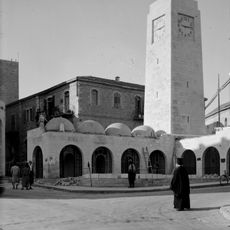
New Gate, Historic gate in Old City, Israel.
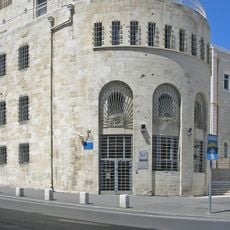
The New Gate is an opening in the northern wall of Jerusalem's Old City in Israel, built from large stone blocks and fitted with metal doors. It leads directly into the Christian Quarter without passing through any other section of the walled city.
The New Gate was cut into the wall in 1889 at the request of the French consul, to link the Notre Dame Hospice, completed in 1886, and the Russian Compound outside the walls with the Christian Quarter and the Church of the Holy Sepulchre. The Ottoman administration named it, while Arab workers called it Bab es Sultan Abd ul Hamid after Sultan Abdul Hamid II, who approved the opening. It was sealed under Jordanian rule and reopened by the Israeli Army in 1967.
The gate is used daily by pilgrims, residents, and visitors moving between the Christian Quarter and the modern streets to the north. Passing through it, one notices how quickly the narrow stone lanes of the Old City give way to open roads and contemporary buildings.
The gate is open to pedestrians during the day and is easy to reach on foot from both the modern city and the Christian Quarter. Visitors heading to the nearby churches and sites will find it the most direct way into this part of the Old City.
Although the name suggests something recent, the walls it was cut into date mainly from the 16th century, built under Suleiman the Magnificent. The gate also carries the Arabic name "Bab al-Jadid," which simply means "the new gate," giving it the same meaning in two languages.
The community of curious travelers
AroundUs brings together thousands of curated places, local tips, and hidden gems, enriched daily by 94,299 contributors worldwide.