Altar on Mount Ebal, Archaeological site at Mount Ebal, Palestine
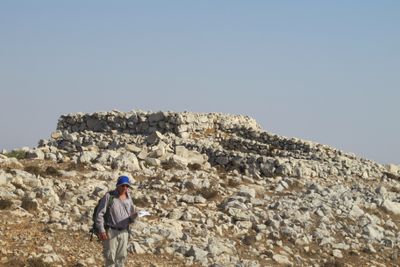
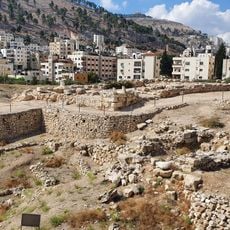
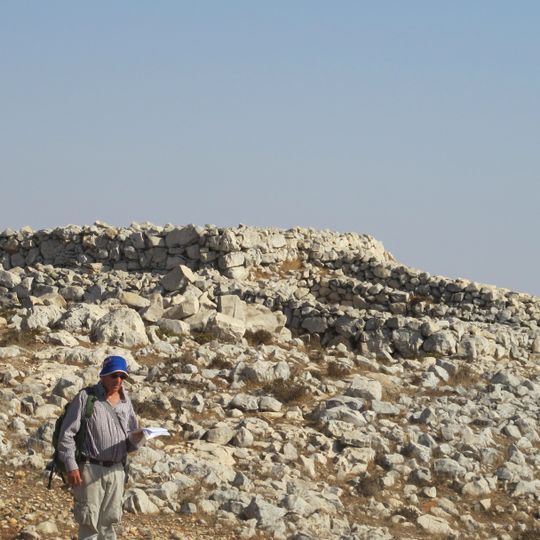
The Altar on Mount Ebal is a walled structure of fieldstones, about 9 by 7 metres and 4 metres high, on the northeastern spur of Mount Ebal at 785 metres. It has no entrance and is filled with layers of stone and ash. Two paved courtyards lie beside it, separated by a ramp.
Adam Zertal found the site in 1980 during the Manasseh Hill Country Survey and excavated it for eight seasons between 1982 and 1989 with the University of Haifa and the Israel Exploration Society. He dated the structure to the last quarter of the 13th century BCE and identified it as Joshua's altar; most archaeologists reject that identification but accept an early Israelite cultic use. In 2021 Palestinian municipal workers damaged part of the site.
The name el-Burnat, Arabic for "the hat", refers to the light-coloured stone mound visible from afar. Excavators found incense vessels, thousands of animal bones and two Egyptian scarabs, one bearing the cartouche of Thutmose III but dated to the time of Ramesses II. A trapezoidal stone seal with lines and dots matched marks on pottery handles.
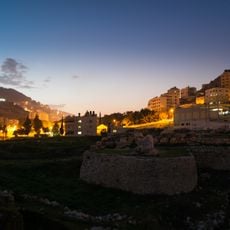
The site sits on the northeastern spur of Mount Ebal, at Northern el-Burnat, a few kilometers east of Asira ash-Shamaliya and northeast of Nablus. It is not marked on maps as an archaeological site, and in 2021 part of the structure was damaged by municipal workers after zoning placed it under Palestinian jurisdiction. Approach on foot from the Nablus area; the stone mound lies on a rocky slope below the 940-meter summit.
The site's most debated find is a trapezoidal stone seal from the end of the Late Bronze Age, engraved with lines and dots in a style also seen on pottery handles found there. Zertal counted dozens of such patterned handles and read them as votive offerings brought to a deity.
The community of curious travelers
AroundUs brings together thousands of curated places, local tips, and hidden gems, enriched daily by 92,639 contributors worldwide.