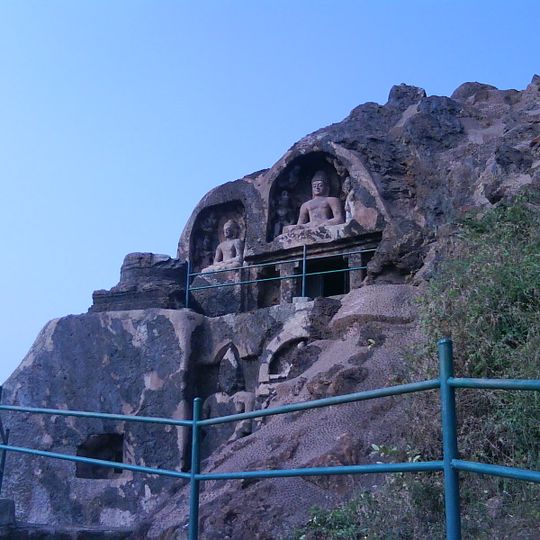
Bojjannakonda, Buddhist rock-cut caves in Sankaram, India.
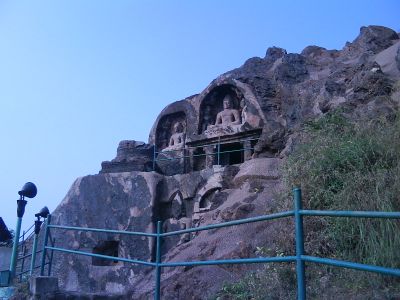
Bojjannakonda is the eastern of two adjacent hills near Sankaram village, about a mile east of Anakapalli. Its rock face holds two arched niches with seated Buddha figures, and below them rectangular openings cut into the stone. A metal railing stands in front of the carved area. The hill is covered with monolithic stupas surrounding the brick-domed Maha stupa.
Bojjannakonda and neighbouring Lingalakonda were Buddhist establishments founded between the 4th and 9th centuries AD, when the village then called Sangharam was largely Buddhist. Coins found on the hill, including one of Samudra Gupta (4th century) and one of the Eastern Chalukya king Vishnuvardhana (633 AD), helped date the settlement. The caves were excavated under Alexander Rim in 1906.
The caves show how Buddhist practitioners of different traditions gathered to pray and meditate over many centuries. You can still see evidence of their daily practices reflected in how the spaces are arranged.
Bojjannakonda lies near Sankaram village, about a mile east of Anakapalli and roughly 45 km from Visakhapatnam. The eastern hill is reached on foot from the village, with the rock-cut caves and stupas set among paddy fields. The climb is short but over uneven rock, and a metal railing stands in front of the carved area.
One cave stands out with sixteen pillars arranged around a carved stupa, while the umbrella design on the ceiling links cleverly to the stupa's peak below. This architectural detail shows the builders' attention to creating visual harmony within the stone.
The community of curious travelers
AroundUs brings together thousands of curated places, local tips, and hidden gems, enriched daily by 92,695 contributors worldwide.