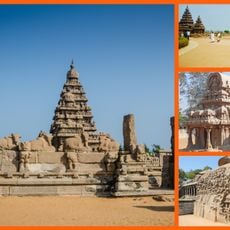
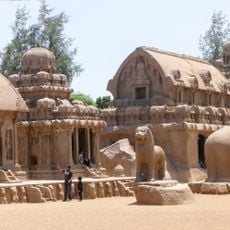
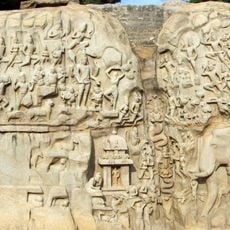
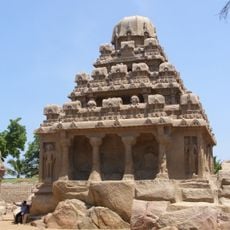
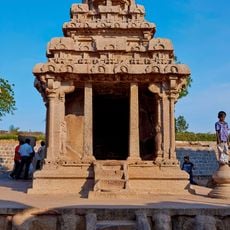
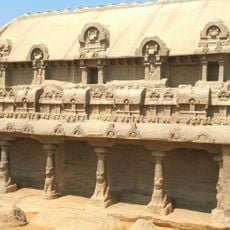
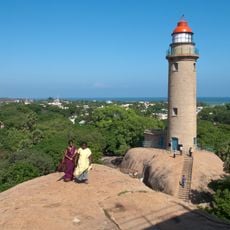
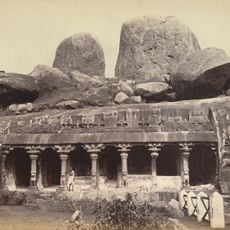
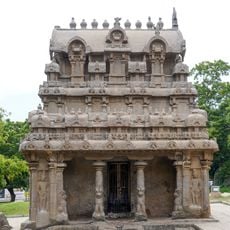
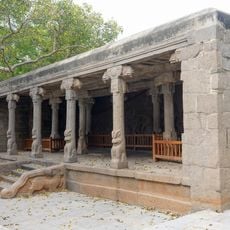
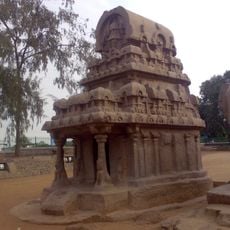
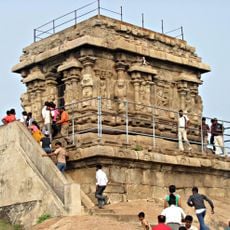
Draupadi Ratha, Rock-cut monument in Mahabalipuram, Tamil Nadu, India
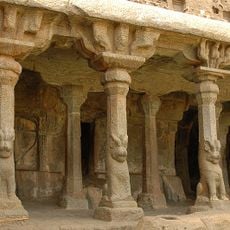
The Draupadi Ratha is the smallest of the five Pancha Rathas, carved from a single long granite stone in the form of a simple hut. It has a square plan measuring 11 by 11 feet (3.4 m × 3.4 m) and rises to 18 feet (5.5 m). Its curvilinear roof ends in a 2.5-foot (0.76 m) square at the top, and the finial is missing. The entrance faces west, reached by a high platform supported by alternating elephant and lion heads, with makara torana arches above the door.
The monument was created during the Pallava Dynasty period in the late 7th century under rulers who advanced building techniques. This dynasty promoted rock-cut architecture as a display of power and architectural knowledge.
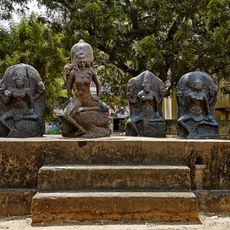
The name Draupadi, wife of the Pandavas in the Mahabharata, was given later and is not supported by the iconography. The sanctum's back wall shows Durga standing on a lotus in sambhaga posture with four arms: upper hands hold a shankha and chakra, one lower hand makes the vara mudra, the other rests on her hip. Two female dwarapalakas guard the door, one with a bow, one with a sword.
The Draupadi Ratha stands at the northern end of the Pancha Rathas, on bedrock that slopes upward toward the south, so the five monuments are met in sequence as you walk the shared plinth. The entrance faces west, up a raised platform, and the sanctum is only about 2 m long by 1.4 m wide, so the carved door frame is best examined from close up.
The ratha is the smallest of the five Pancha Rathas, measuring 11 by 11 feet at the base and rising 18 feet, with a curvilinear roof ending in a 2.5-foot square at the top. Its missing finial and uncarved bedrock at the pinnacle show the work stopped when Narasimhavarman I died in 668 AD.
The community of curious travelers
AroundUs brings together thousands of curated places, local tips, and hidden gems, enriched daily by 94,283 contributors worldwide.